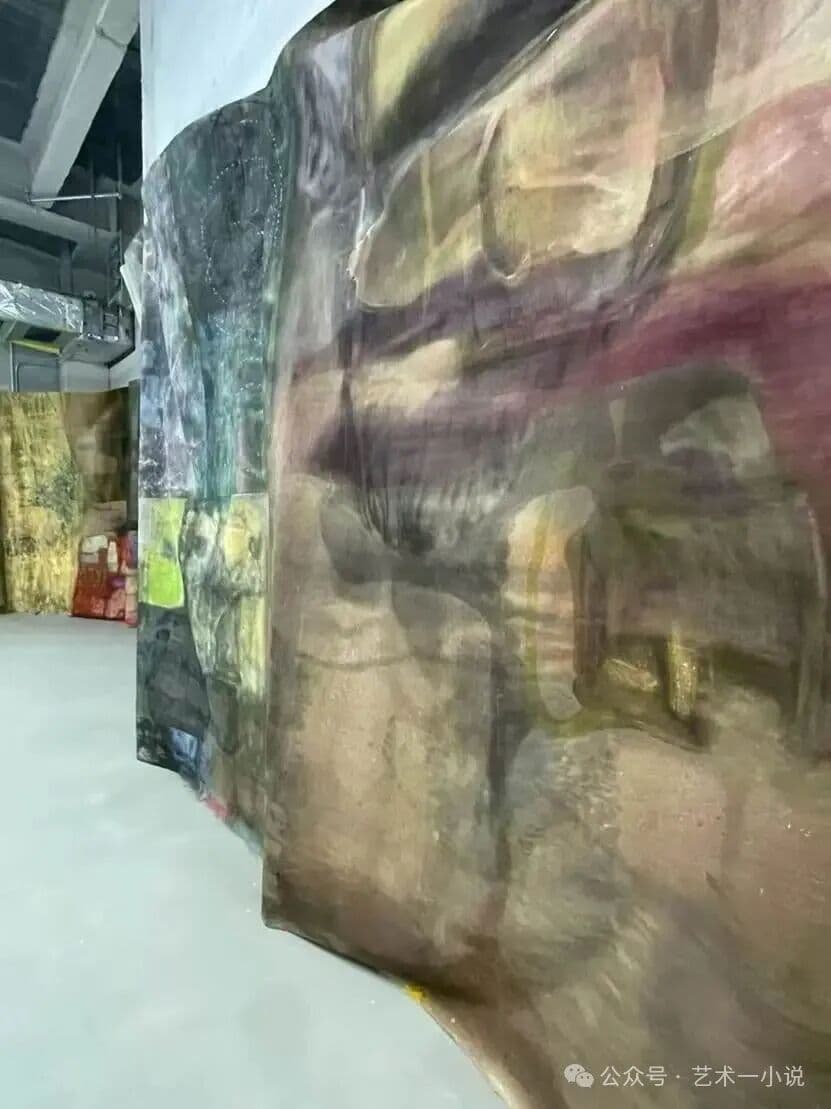
In Yang Yang’s latest exhibition, Weatherers, presented in DONG’s newest paste-space, painting takes a single step backward—returning to the tradition of the Lascaux cave paintings from over 30,000 years ago. The exhibition treats Dunhuang as a relay station in the translation of images, using this deep historical measure to reassess the archetype of painting on a planetary scale. In doing so, it strikes the nerve of today’s painting world—the one stretched taut by market value—and dramatically expands what it means both to paint and to look at painting.
The entire exhibition is a single painting, yet at the same time it is an installation, a sculpture, and a film—or even a mobile phone screen. As you move through the space, it becomes a moving image: a film, or perhaps a short-form video. At a cinematic 2:1 scale, it draws you inside, turning you into one of its ingredients, dipping you into itself and swallowing you whole, making you part of its montage.
And if you were to sell it, it would still be a painting. Above all, it is a painting—indeed, a painting in a broader sense than most others. Once folded and packed away, it barely occupies any storage space. It is a painting that contains within itself 45,000 years of painting’s prehistory and afterlife—from Neanderthal cave painting (see Jörg Heiser, Ice Age Art: Contemporary Resonances, Part 2; and the recent essay: https://www.e-flux.com/notes/6783416/ice-age-art-contemporary-resonances-part-2) to the present.
Placed before us, we can point to it and say: this is the kind of painting we mean—a form that extends far beyond the six-thousand-year timeline defined by the combined traditions of East and West; a deep painting that is simultaneously prehistoric and hyper-contemporary, absorbing the present into itself. It is our 2025 handmade version of ChatGPT—or GDP—for the history of global painting.
Seen in this light, we can remain remarkably composed in the face of AI image generation, viewers’ growing aversion to framed paintings, or the fashionable habit of collectors treating framed canvases like glamorous bodies to be traded on the market. This exhibition allows us to confront all of these phenomena with a renewed sense of perspective and poise.
This is a painting situated within deep time—or rather, vertical time, geological time. It decisively dispenses with the sentimental baggage that so many painters habitually parade: the drama of personal introspection, autobiographical reflection, the preciousness of private intimacy, lingering obsessions with the Cultural Revolution, nostalgia for the countryside or historic architecture, and the endless seepage of spiritual and cultural nostalgia.
Once these familiar sentimentalisms of contemporary painting have been stripped away, what remains is the distinctly Yang-like quality of Yang Yang’s practice.
The inaugural exhibition at DONG. A single painting made in 2025, situated within 45,000 years of planetary painting history—a work that simultaneously contains Neanderthal cave paintings, Dunhuang, Ni Yunlin, Rubens, Instagram, and Douyin short videos. One painting, in other words, is an exhibition in itself.
Much like a single carpet belonging to a nomadic tribe on the Central Asian steppe can stand for an entire civilisation.
Following Vilém Flusser, painting originates in the carpet, the tent, the wall, and the screen. It exists as a ghost dissolved into this long history of images, repeatedly slipping out of focus only to return again. Seen from a great distance, the overall shape of painting history is precisely what Yang Yang’s Weatherers looks like.
This exhibition opens a new path for painting—like walking a quiet morning trail over a thin layer of fresh snow.
It folds the entire history of painting—from Modernism, or even Classicism, or further back to Greece and Rome, or even ancient Egypt, all the way to Douyin short-form video—into a single, comprehensive history of image-making. It folds this history as lightly as a linen shirt, places it neatly into a cupboard, and says:
That was merely the prelude.
We know full well that all of it is relentlessly becoming the past. It deserves to be carefully stored away. Yet, regardless, we must begin again.
From the cave, back to the cave.
Let us list several flawed attempts so far to contain the history of global painting:
- Hockney and Gayford’s A History of Pictures: From the Cave to the Computer Screen merely states that pictures have two traditional sources: one Egyptian-European-American, the other Chinese-Japanese. Global picture history is thus composed of these two clear streams.
- *Hubert Damisch’s A Theory of /Cloud/ argues that only after Correggio did Western perspective finally part ways with Chinese “cloud” painting. Before that, Chinese and Western painting could not truly be separated.
- Bataille’s The Cradle of Humanity: Prehistoric Art and Culture suggests that sacrifice and festival overturned the order of utilitarian objects inside the cave. The expectations and desires of hunters and cave dwellers determined why images were made on rock in this way. Their cave paintings ask us no longer to deny what we are, but to become human at all costs—to exist according to our expectations and desires, and also to become what we are not. A cave dweller, stirred by desire, decides to draw his own shadow askew, in order to “objectify his negativity” in Hegel’s sense. He thus expresses his own existence as a hand reaching toward the impossible.
- Didi-Huberman, in The Joyous Science of Seeing (p. 311), contracts the scale of global painting history: the Lascaux cave paintings are unsigned collective works, in which today covers yesterday. They express what Bataille called “the joyous knowledge of childhood.” Possibly created collectively over ten thousand years, what we see in them is a “constellation of life.” These murals renew the modern viewer: they connect, or short-circuit, contemporary people with humans from thirty thousand years ago. They tell us what constitutes the human. They also tell us what artistic creation is, and what painting is.
- And according to Stiegler, ChatGPT search results should also tell us who we are, just as these cave paintings do. But do they really? Can they really? In the end, we are startled to discover that ChatGPT captures our age like a spider’s web: a cave painting, or web, spun by a spider-spirit, in which the more we struggle, the tighter we are bound. To understand what we are from within it becomes even harder. Yet however difficult it may be, we still have to cut a path through it, so that the space in front of our cave remains open. Every new painting must be such an opening. Otherwise, painting is merely something one does after eating too much—mistaking sentimentality for interest.
- Carbone and Lingua’s Toward an Anthropology of Screens (p. 36) notes that the filmmaker Herzog saw, in the Hollywood musical Swing Time, Fred Astaire dancing in competition with his own shadow. But Herzog failed to realise that this has always been the human condition. In the cave, we saw the shadow of our own hand and then withdrew the hand. This was our earliest screen experience, and the beginning of dance. Marc Azéma’s The Prehistory of Cinema (2011) argues that cinema has no single point of invention; it has accompanied us since the caves of thirty thousand years ago. The French paleoanthropologist Michel Lorblanchet describes humans in the cave thirty thousand years ago as using the hand as a screen: wherever pigment could be blown over the hand onto the rock, there the screen began. The hand partially replaced the whole body and assumed the function of the proto-screen. The hand was the first medium of shadow theatre. At that time, the hand was both brush and projector.
Stiegler, in Lessons from Greta Thunberg: The Neganthropocene, Part II (pp. 270–71), argues that although Derrida introduced the concept of the supplement, he never fully distinguished between endosomatization (incorporation within the body) and exosomatization (technical exteriorization). Nor, according to Stiegler, did Heidegger. As a result, neither was able to grasp what the cave truly is.
Today, we inhabit precisely such a cave—one constituted by the digital, exosomatic layer of mindless technical matter. We live inside what Stiegler calls exosomatic supplements (la supplémentarité exo-somatique), a cave built from hyper-material technologies such as 6G chips. The iPhone is our true inferno.
We must all become Orpheus. We must each learn our own way of singing.
Every piece of information is itself a cave painting. It is only because we refuse to understand it that we allow ourselves to be used and manipulated by it. From this perspective, the artist’s great task today is to create every single piece of information as though it were a cave painting—just as Wang Jianwei, for example, reworked a painting according to the day on which global warming occurred.
On MadeIn Company’s Entry into DONG
Having emerged from the cave, humanity invented the carpet. The carpet became a wall-screen, a windbreak; it became an umbrella, a circus tent, a parachute, a kite, and the sail of a mast. Yet the stone house, in turn, resembles another cave, enclosing our darkest secret.
We continually move into caves that are more comfortable—and at the same time, darker.
The cave closest to us today is the screen, or Google, or the search results generated by ChatGPT. The screen has no true origin, because we have always existed in a dialectic between the nest and the cave. When one cave becomes exhausted, we are compelled to enter another.
We can only keep advancing toward ever newer caves—toward the sphere, the bubble—throwing ourselves into them in order to remain suspended upon the surface of the Earth, clinging to it with the same desperate determination that a gymnast uses to stay balanced upon the beam.
The cave is the destination of our dwelling.
The more comfortable a room becomes, the closer it comes to becoming a
burrow
. Everything about the human being is already non-natural.
Within us, the nest and the burrow are opposing yet inseparable forces. What is difficult to locate—like something beyond the reach of GPS—is our nest, but before long it hardens into a burrow. Human existence is forever suspended in the dialectic between nest and burrow, grassland and river, herdsman and farmer, tent and house. Our destiny oscillates between these paired conditions.
The burrow is the world of seamless convenience. For the contemporary artist, it is the clamour of commercial art: market-driven paintings, prices, galleries, museums, art academies, and even art history itself. The cave, by contrast, is a place where one is nothing at all—a place one can enter only after stripping everything away.
After six thousand years of civilisation, we have painstakingly travelled from the cave to the burrow. Yet before long, the burrow begins to stink, and we are compelled to seek another cave.
The cave, at least, remains open. It is still a stage. The burrow, by contrast, resembles a gated compound or an internment enclosure: the collector’s penthouse crammed with commercial artworks, or the booth of an art fair.
It is only in the cave, within ourselves, that painting may recover its own voice in song.