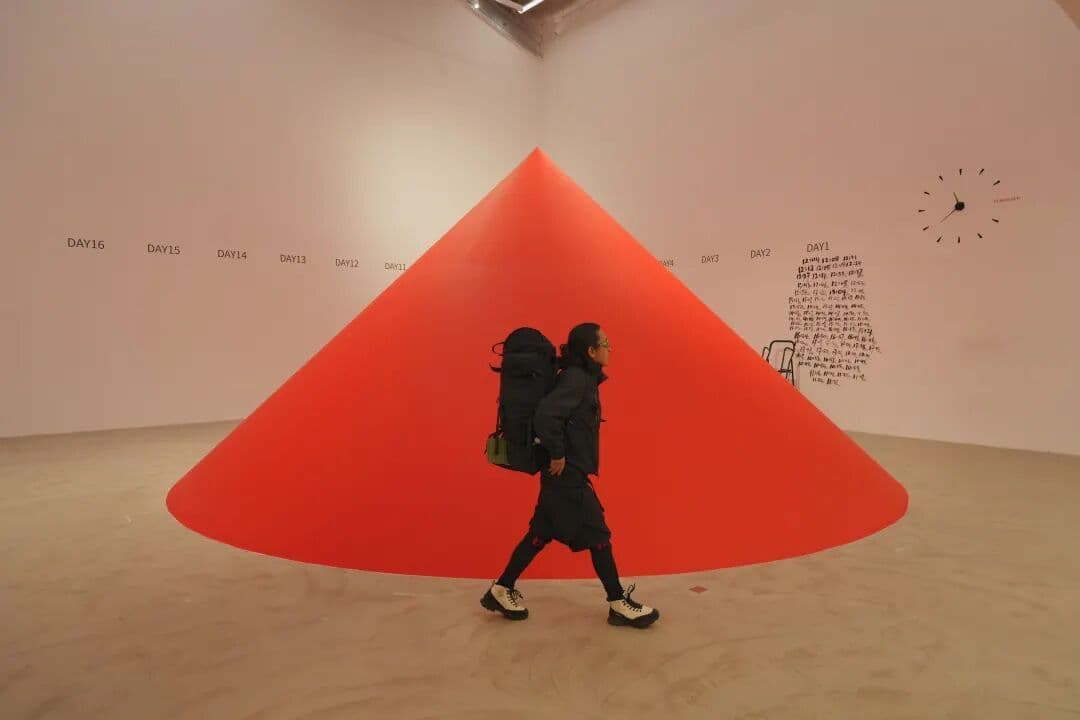
Artist Liu Chengrui’s latest solo exhibition, The Remaining Disciple, is currently on view at Youbian Space in Beijing. Coinciding with the exhibition, the artist has also launched a 21-day durational performance project. This article presents an exhibition review written by Mirror, offering a critical reading of the exhibition and its broader conceptual framework.
The hunger artist imprisons himself inside a cage. Dressed in black, skin-tight clothing, gaunt, with his ribs protruding, he sits silently upon a pile of straw, like a deflated wallet, waiting for the day when hunger will finally consume him.
For most visitors, eager only to relieve their own boredom, this form of performance—devoid of theatrical spectacle or dramatic action—seems unbearably tedious. Beyond the endless suspicions that the artist is merely a fraud putting on an act, many dismiss his self-imposed suffering with open contempt.
The years of famine have long since passed. The number of people struggling with excess has long surpassed those reduced to skin and bone by hunger. There are now more people idle through abundance than labouring desperately simply to survive. Hunger no longer appears to stand for anything; it no longer seems capable of expressing anything. Most people no longer know what genuine hunger is. They look at him no differently from the way they would glance at a starving homeless man on the side of the road.
And yet, despite all this, visitors continue to arrive in an unbroken stream throughout those weeks to watch him.
The hunger artist’s greatest skill is simply not eating—or rather, doing nothing at all. Like the labouring bodies outside his cage, he does not regard himself as an object of spectacle. He has lived in this condition for half his life and expects to continue doing so for the remainder of it, until his body is finally surrendered to death.
He believes he could sustain this ordeal far longer than anyone would imagine, though he himself has long ceased to remember exactly how many days he has gone without food. In the end, he no longer counts the days; instead, he measures only the distance between himself and death.
To give the performance a tangible structure, a clock is placed inside the cage. It is the only object the hunger artist actively uses, and the only thing capable of producing any form of surplus within the work. The audience, in effect, pays for the unmanaged accumulation of empty, passing time. Softly repeating the same words to himself, he murmurs:
“I will go on.”
—or, more precisely,
“I will keep fasting.”
The duration of the performance was fixed at forty days. The hunger artist knew that this would naturally lead people to assume that such a span marked the upper limit of what an ordinary person could endure without food. The real reason, however, had nothing to do with human endurance. Rather, the manager who organised the performance believed that once the fast exceeded this period, the public would lose both its curiosity and its patience. Without spectators willing to buy tickets, there would be no audience left to watch the hunger artist in his cage.
In truth, the hunger artist had no desire for the performance to end. When the appointed day arrived, the jubilant crowd would feel relieved on his behalf, convinced that he could finally rest and be rescued through nourishment. For him, however, this was nothing more than an unwelcome act of coercion, interrupting his chance to surpass himself.
Yet what tormented him most was neither the premature end of his artistic pursuit nor the prospect of an empty room without spectators. Rather, it was the guards who, late at night, secretly fed him out of excessive concern. Their actions filled him with unbearable shame and despair. By day he was almost too embarrassed to meet another person’s gaze. He kept his head lowered, speaking only in hushed tones, as though the deception had become obvious to everyone and they merely chose, out of pity, not to expose it.
Fasting was the only thing he knew how to do. Beyond that, he was good at nothing.
In earlier years, he would amuse himself by teasing the guards, inventing little tricks simply to watch them gorge themselves with hearty appetites. Now, however, he had grown withdrawn and despondent, attending only to the lonely labour of his own ordeal.
The hunger artist becomes a saint—or perhaps a “remaining disciple”: a celebrated ascetic whose existence ultimately resists understanding. He is a figure of double negation, performing what is most natural—labour (sitting still, circling endlessly)—while denying another equally natural instinct: life itself (eating, comfort). In this sense, he assumes the impossible position of a god who negates both action and survival.
The hunger artist never concerns himself with the meaning of hunger. To him, hunger is simply one of the body’s most bearable forms of suffering. There are countless other agonies—tearing, bruising, piercing pain—that are far more unbearable. His body instinctively, almost effortlessly, chooses fasting as the least demanding form of labour, one that consumes virtually nothing except time—and even time, for him, is not something expended.
“The entire procedure is clear from the outset: it is the only procedure devoted to the discourse, dialogue, and utterance of the body. Once the body is committed to this project—to any project—the body itself has already been set aside.” [1]
As a saint, the hunger artist’s gestures, words, and very image become increasingly inexpressible. His limbs grow numb; half of his body aches from remaining in the same position for so long. He desperately needs rest, yet he has done nothing at all. He resents being suspected, even though his performance has begun to reveal its own contradictions. He longs for admiration, only to find himself gradually forgotten. He hopes that the body might speak in place of language, yet the body is precisely the language he seeks to articulate. Such a language—untouchable, unspeakable by nature—seems destined, at least to some extent, to fail.
In constructing his own condition, the artist performs an Aufhebung of the body as a living organism. He suspends its biological essence and commits himself entirely to a state named “hunger,” allowing meaning to emerge from within the flesh itself, “as light penetrates Plato’s cave.”
Hunger signifies the refusal of nourishment—the sublation of the living body—and, at the same time, the death of labour as a deferred symbolic act, or what Jacques Derrida terms différance. What the hunger artist possesses and exercises is not the power to decide when to end this prolonged ordeal, nor simply the ability to endure starvation. Rather, it is the power of Sinnverkehrung—the reversal of meaning itself:
the reversal of non-action into action;
the reversal of completion into interruption;
the reversal of interest;
the reversal of purpose.
Only at the very end does he reveal the reason for his fasting:
“It wasn’t that I insisted on starving myself. I simply could never find any food that suited my appetite.”
This essay draws upon Franz Kafka’sA Hunger Artist (Ein Hungerkünstler) as a metonymic framework through which to reflect on Liu Chengrui’s twenty-one-day performance, Remainder, presented at Youbian Space. The artist devised a strict daily schedule of labour: each cycle consisted of circling a red conical structure seven times, suddenly crashing his body into the wall, pausing briefly to catch his breath, and leaving behind a temporal mark. Throughout the performance, the only momentary relief from exhaustion came from the time that viewers devoted to his labour and speech—the time they effectively “paid” for through their attention.
Compared with earlier works such as Ultimate Corporate Slave (2023) and A Red Sun, Liu articulates the relationship between the body, labour, and expenditure in a more elemental form. The body is no longer configured as a sensorial apparatus embedded within political systems or cultural coercion; instead, it appears simply as a working body—calloused and toiling, no different from the bodies outside the “cage.”
If performance inevitably hinges upon the interrelation of body, labour, and expenditure, then within the programme Liu has established, the body’s relation to the outside world is immediately apparent. It is not concerned with image or technological mediation. Rather, the body functions as a symbolic organ, an instrument of signs, while the “cage” itself becomes a cave filled by the artist—a murky space of interiority. At this moment, the body (itself a constructed cave) does not speak directly; it is continually veiled by symbols and representation.
Language, meanwhile, abandons the author, surfacing only in fragments through Poetic Delivery. The performance thus becomes, in essence, an act of exchange between text and the outside world—a site where language acquires a kind of synaesthetic resonance. Within this field, constituted through the exchange of value, what emerges is what Roland Barthes described as “the jouissance of the body” produced by the writerly text.[2]
As a labourer, Liu Chengrui establishes a form of symbolic exchange (L’échange symbolique) by bringing together wages—as signs—and writing as a fundamentally non-productive activity. Much like Kafka’s hunger artist, who constructs an equivalence between remuneration and non-labour, Liu’s performance becomes an exercise in mastering discourse while simultaneously unfolding the self through the act of writing.
About the Artist: Liu Chengrui
Liu Chengrui (b. 1983, Qinghai, China) was raised in a semi-nomadic family and graduated from the Department of Fine Arts at Qinghai Normal University in 2005. He currently lives and works in Beijing. His practice spans performance, painting, and writing.
In 2006, Liu initiated the Ten-Year Plan on the shores of Qinghai Lake, a long-term project that has become the humanistic foundation of his artistic practice. Bound together with numerous participants through a shared promise, the project seeks to reshape individual life trajectories and social identities. His work strives to approach the resolve and poetic sensibility of ordinary people, employing motifs drawn from mythology, fable, and consumer culture to articulate a powerful personal will alongside the complexities of contemporary spiritual life.
Poetry serves as the primary source of Liu’s imagination. He runs the daily poetry subscription platform Punishing Pride and has independently published three collections of poetry: Sadness (2017), Thus the River (2013), and Which Road Leads East (2004).
About the Author
Mirror is a writer and curator, currently pursuing a PhD in Contemporary Art Theory at the Beijing Film Academy. Their research focuses on the relationship between photographic images, text, and media within the visual regimes of modernity.