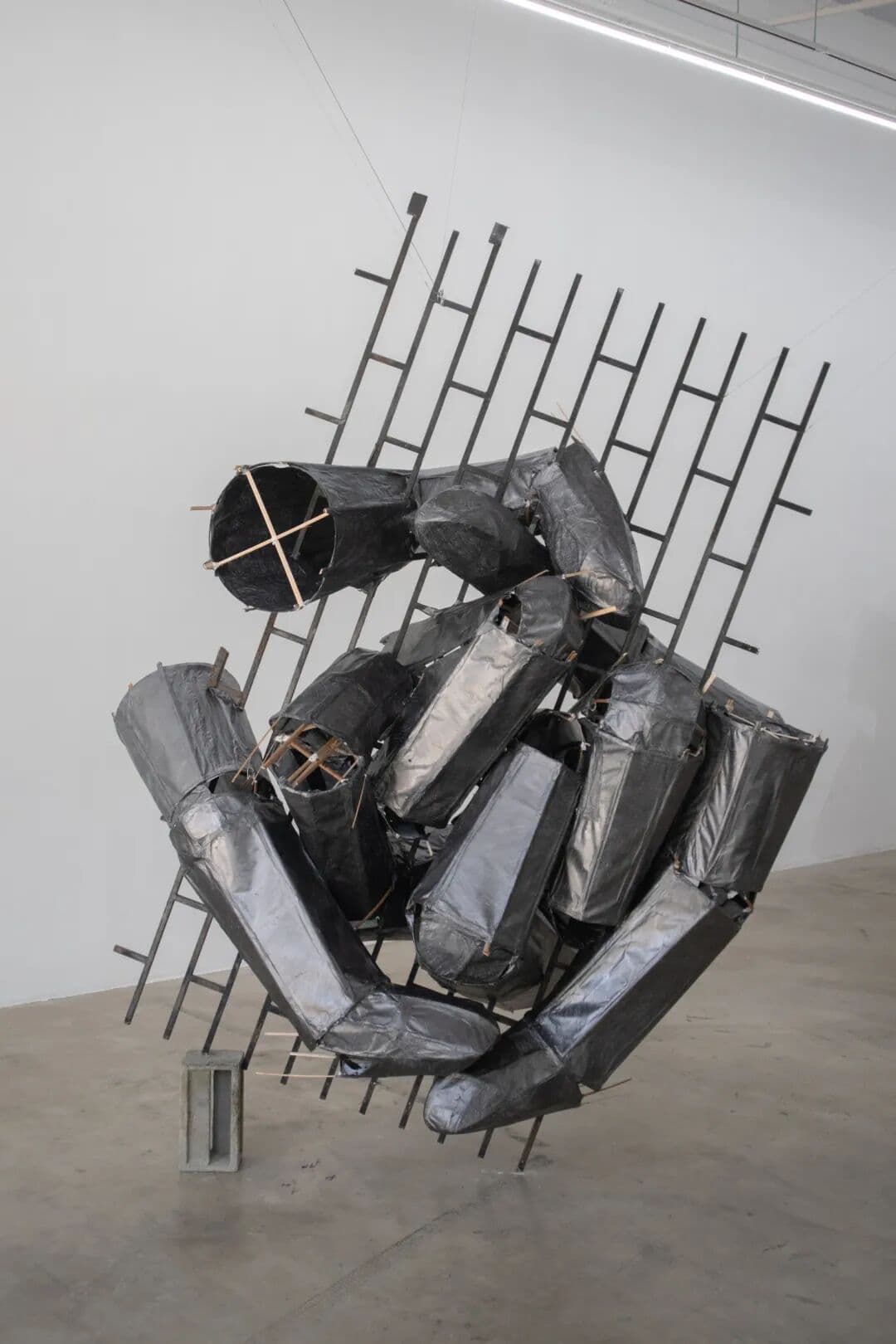
Invited by the Malaysian non-profit organisation Blank Canvas, artist He An travelled to Penang on three separate occasions as part of the organisation’s residency programme. During his first visit in August 2024, he observed a wide range of local religious rituals and community practices. In July 2025, he undertook a 25-day self-driven field trip across both the east and west coasts of Peninsular Malaysia, conducting broader research into the country’s cultural landscape and social structures. Returning to Penang for a third time in January 2026, He worked closely with local artisans involved in ritual and ceremonial practices, seeking to connect his own experiences with the evolving cultural identity of the local Chinese Malaysian community.
By Fanning the Fire, Little Effort Is Needed, He An’s solo exhibition, is the artist’s response to these three visits to Malaysia under Blank Canvas’s annual residency programme. The project is presented in collaboration with Blank Canvas and Yishi Space.
By Fanning the Fire, Little Effort Is Needed is a phrase from the Zengguang Xianwen (Expanded Worthies), originally derived from a Chan Buddhist verse recorded in the Jingde Record of the Transmission of the Lamp. Much of Chan Buddhism’s language operates through a productive tension between literal expression and inner transmission. On the surface, the phrase appears to offer practical advice—to make use of natural forces in order to achieve an outcome. At a deeper level, however, it describes an experience of time, rather than a method of action.
Within the Zengguang Xianwen, a text shaped by simplified Confucian ethics, the phrase is recontextualised as a lesson in worldly conduct—a strategy for navigating human affairs. Although the wording remains the same, its orientation shifts dramatically between the two texts. Suspended between what is spoken and what remains unsaid, the phrase simultaneously invokes and empties Confucian ethical frameworks, creating a space that both traverses and unsettles them.
What interests He An is the phrase’s subsequent transformation into a moral maxim with strong didactic overtones, before eventually returning to the form of a nursery rhyme—rhythmic, instinctive, and almost effortless in its recitation. For the artist, this continual migration across contexts resembles a fluid movement between Western notions of unconscious textual production and the idea of the significant form, where meaning is generated through the shifting interplay of language, rhythm, and form rather than through any fixed interpretation.
In the contemporary context, By Fanning the Fire, Little Effort Is Needed also reads like a quiet, almost whispered annotation—one that carries with it a subtle slippage of meaning, allowing unconscious action to become a form of representation. He An chose this phrase precisely because it observes things not as fixed objects but as conditions and phenomena, while simultaneously pointing to an ethical worldview that has taken shape within a cultural tradition spanning more than a millennium.
Within the context of this exhibition, the title places greater emphasis on gathering seemingly unmotivated emotions as a way of rehearsing emptiness and response—a mode of silent inscription rather than explicit declaration. Recontextualised in Penang, the phrase becomes an oblique metaphor for the posture and modes of expression through which the local Chinese community has historically understood and articulated itself.
The history of the Chinese community in Malaysia is both long and deeply entangled with the complexities of contemporary identity and geopolitics. Here, individuals are continually woven into the festivals, rituals, and collective celebrations of their own communities. At the same time, the innate generosity that underlies these communal practices gives personal identity a distinct cultural narrative and set of boundaries.
By choosing a concise, Chan-like phrase marked by its abrupt, aphoristic quality, He An invokes a distinctly Eastern mode of wisdom and ethical reflection. Within today’s overlapping and repeatedly rehearsed political discourses surrounding ethnicity, identity, and belonging, this very syntax becomes a gesture that is at once silent and articulate—a movement of crossing over and returning, speaking precisely through what it leaves unsaid.
About the Artist: He An
He An (b. 1970, Wuhan, China) lives and works in Beijing. He studied at the Hubei Institute of Fine Arts. Working across a wide range of media, his practice frequently combines industrial materials to create immersive installations rich in sensory and narrative dimensions.
He has presented solo exhibitions at institutions and galleries including the Australian Centre for Contemporary Art (ACCA), UCCA Center for Contemporary Art, OCT Boxes Art Museum, Galerie Templon, Tang Contemporary Art, MadeIn Gallery, HdM Gallery, and Magician Space, among others.
His work has also been featured in numerous major international group exhibitions, including I Loved You (White Rabbit Gallery, Sydney, 2022); Garden State: People in Chinese Gardens (Pingshan Art Museum / OCT Boxes Art Museum, Shenzhen / Shunde, 2020); Art Changsha 2019 (Hunan Museum, Changsha, 2019); Entropy (Fondazione Lin Yuan, Venice, 2019); Beyond Pop Art (Yuz Museum, Shanghai, 2016); Post Pop: East Meets West (Saatchi Gallery, London, 2014); the Carnegie International (Carnegie Museum of Art, Pittsburgh, 2013); Rendez-vous 2008 (Musée d’Art Contemporain de Lyon, Lyon, 2008); and The Real Thing: Contemporary Art from China (Tate Liverpool, Liverpool, 2007), among others.
About Blank Canvas
Blank Canvas is a non-profit organisation based in Penang, Malaysia. It is dedicated to serving as a bridge between Penang and its surrounding region and the international contemporary art world. The organisation aims to deepen local awareness and appreciation of both Malaysian and international contemporary art, while encouraging international contemporary art practitioners to explore and engage with cultural exchange in Penang and the wider region.