Forever Tomorrow: Chinese Art Now is a major group exhibition presented by Auckland Art Gallery in 2026, bringing together more than sixty works by over forty artists across a wide range of media, including video, installation, and sculpture. Tracing the development of contemporary Chinese art from the 1980s to the present, the exhibition offers both a comprehensive survey of a pivotal period and the largest presentation of contemporary Chinese art to date. Framed by the profound social transformations that have shaped China over recent decades, the exhibition places artists from different generations in dialogue, revealing the complexities of the country’s cultural landscape amid globalization and technological change. Xu Zhen’s work is featured as an integral part of this broader narrative. As one of New Zealand’s leading public art museums, Auckland Art Gallery has long been committed to presenting significant international exhibitions and fostering cross-cultural dialogue, maintaining a sustained scholarly and curatorial influence across the Asia-Pacific region.
Forever Tomorrow: Chinese Art Now presents pioneering practices in contemporary Chinese art through a wide range of media, including sculpture, photography, and digital art. Closely attuned to the present moment, the exhibition examines key issues such as rapid change and social transformation. Beginning with China’s Reform and Opening-Up in 1978, it spans several decades of artistic development and focuses on how a new generation of Chinese artists has responded to profound shifts in social structures — from rural to urban life, from tradition to modernity, and from industrialisation to globalisation.
The exhibition brings together major works by internationally significant artists including Xu Bing, Xu Zhen, and Yang Fudong, while also introducing a number of leading contemporary artists exhibiting in New Zealand for the first time, among them Lu Yang, Zhang Peili, and Wang Tuo, winner of the 2024 Sigg Prize. Through contemporary reinterpretations of traditional Chinese craftsmanship, imposing mechanical sculptures, and contemplative digital landscapes, Forever Tomorrow: Chinese Art Now reveals the complexity, innovation, and forward-looking vision of contemporary Chinese art, inviting audiences into a dynamic cultural field in constant evolution.
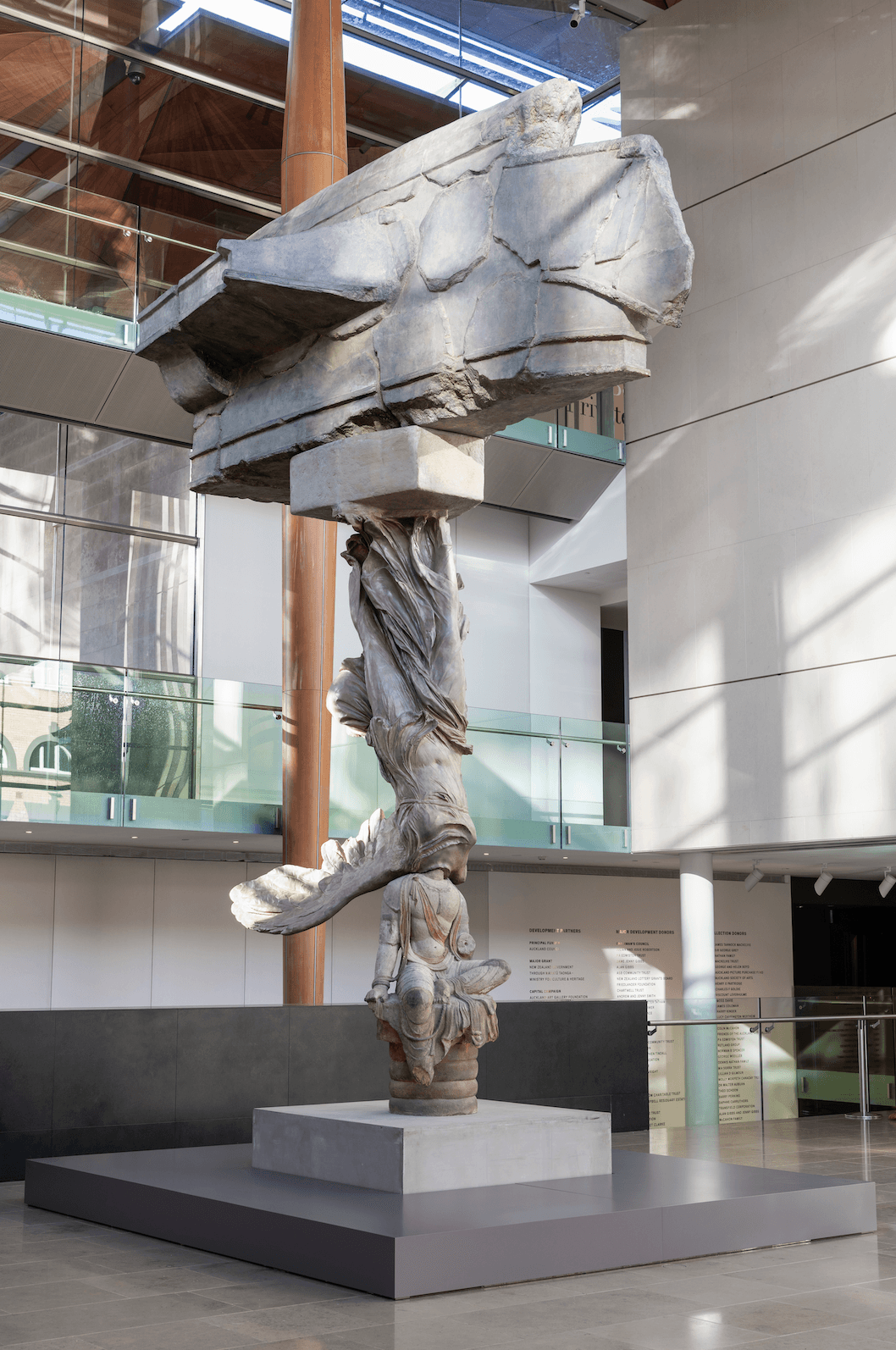
In the museum’s light-filled vertical atrium, Xu Zhen’s monumental sculpture Eternity – The Half-Seated Bodhisattva from Tianlongshan Grottoes, Winged Victory of Samothrace is presented as a major work in Forever Tomorrow: Chinese Art Now.
Over the years, this iconic architectural hall has hosted large-scale site-specific installations by leading international and local artists, including Olafur Eliasson, Tino Sehgal, Simon Denny, and Judy Darragh.
Hutch Wilco, curator of the exhibition, states: “Forever Tomorrow: Chinese Art Now brings together powerful works that speak to lived experience — labour, migration, family, intimacy, and technology. Spanning different generations, these works show how artists give material form to the emotional and psychological dimensions of everyday life. Taken together, they create a vivid portrait of contemporary experience, inviting audiences to consider how these changes continue to shape individual lives and shared futures.”
Eternity – The Half-Seated Bodhisattva from the Tianlongshan Grottoes, Winged Victory of Samothrace (2014), currently on view at Auckland Art Gallery, was first presented in Xu Zhen’s solo exhibition Xu Zhen: MadeIn Company at the Ullens Center for Contemporary Art (UCCA), Beijing, in 2014. The work was subsequently exhibited in Bentu: Chinese Artists in a Time of Turbulence and Transformation at the Fondation Louis Vuitton, Paris, in 2016, where it was later acquired for the museum’s collection.
From Thursday, 2 April, Xu Zhen’s monumental sculpture Eternity – The Half-Seated Bodhisattva from the Tianlongshan Grottoes, Winged Victory of Samothrace has been installed in the main atrium of Auckland Art Gallery as part of Forever Tomorrow: Chinese Art Now.
The Eternity series draws upon headless sculptures from museums around the world, spanning both Eastern and Western traditions. Xu Zhen recasts these fragmented classical works, transforming them into new sculptural compositions. The missing heads of the original sculptures are replaced with equally damaged, headless fragments sourced from museums across different cultures and historical contexts.
These works—once celebrated as timeless masterpieces and embodiments of immortal gods and Buddhas—represent some of the highest achievements of human civilisation. At the same time, they bear witness to histories of colonialism, violence, and the complex, entangled relationships through which cultures have conflicted, intersected, and coexisted.
By reconfiguring these enduring icons of Eastern and Western art history, Xu Zhen creates a visual encounter that is far more unsettling than the familiar aesthetic of the fragmented classical statue. His sculptures not only evoke the grandeur and authority of art history, but also allude to humanity’s Babel-like condition—marked by divisions that appear perpetually irreconcilable. Yet within these unlikely unions, the works also suggest an ethos of inclusiveness rooted in Eastern philosophy, proposing coexistence rather than opposition as a way of understanding cultural difference.
At first glance, these works appear to reinforce the conventional notion that different regions constitute separate spheres of cultural development, each associated with fundamentally distinct forms of religious experience and political life. In Eternity (East Pediment of the Parthenon), Xu Zhen uses the Parthenon as the sole structural support for an inverted Buddhist figure. The gesture can even be read as an ironic cultural metaphor: the West is conventionally associated with a stable material foundation, while the East is imagined as inhabiting a suspended spiritual realm.
Yet within the broader context of Xu Zhen’s artistic practice, this fusion of sculptural vocabularies extends far beyond a simple opposition between cultures. Instead, it points to the transformation of historical material remains into “informational objects”—media that encode and transmit cultural memory, or what might be understood as “cultural genes.” When these disparate elements are brought together, as Xu Zhen himself has observed, “the relationships between them feel entirely natural, as though they were always meant to coexist… only to be redefined and recomposed.”
— Alex Burchmore, art historian and writer, excerpted from “Xu Zhen: Eternity Vs. Evolution” at the National Gallery of Australia, Canberra (2020), Randian.
In a 2015 conversation with Philip Tinari, Xu Zhen linked this mode of recombination to the loosening of singular cultural identity in a post-internet context, to the point that it becomes “difficult to tell who made a work, or whether it comes from China or from another cultural background.”
Within this logic, the spaces adorned with these ambiguous transcultural, hybrid signs — such as the monumental Brutalist volume of the exhibition hall at the National Gallery of Australia — assume an almost universal symbolic scale. Like the dome of a conqueror, they become sites where the “trophies” of different histories and cultures contend with one another. Their original meanings and specificities are repeatedly stripped away, before being rearranged and re-inscribed with new significance within the context of display.
— Alex Burchmore
Viewed from the front, European Thousand-Armed Classical Sculpture (2014) creates an illusion of unity — or, perhaps more precisely, an illusion of trans-subjectivity. A series of sculptural figures representing European and North American deities and allegorical personifications are incorporated into a composite image of Guanyin, as though reconstructing a likeness of the Thousand-Armed Guanyin, the embodiment of compassion.
Yet this unity collapses the moment the viewer moves around the sculpture. The ruptures and artificial joins within its internal structure become clearly visible, revealing the fragmentary and constructed nature of the work. These material fissures seem to correspond to an equally fragile and deliberately fabricated ideal: the utopian imagination of geopolitical harmony, or of a universal fusion of belief systems — an ideal to which many idealists have long devoted themselves.
— Alex Burchmore
Art historian Paz Monge comments: “The Eternity series embodies a spirit of contempt for, and resistance to, banal forms of cultural exchange among contemporary Chinese artists… In the Eternity series, Xu Zhen presents deliberately constructed relationships and understandings between Eastern and Western cultures, as well as the artificially produced interactions between them. If its conceptual structure is overlooked, Eternity could easily be read as a blunt and controversial collage of divine iconography. Yet through Derrida’s linguistic model, we are able to reconsider the sharp and rigorous theoretical structure of Xu Zhen’s work. Fundamentally, as Xu Zhen continues to appear across both Eastern and Western art worlds, we are also able to affirm that art can indeed transcend cultural boundaries and exist as something universal.”
— Paz Monge, Curator, Guggenheim Abu Dhabi, excerpted from “In What Ways Could an Art Object Made in One Place Resonate in Another? Art by Xu Zhen” (2017)
About the Artist | Xu Zhen
Xu Zhen is an artist, curator, and cultural entrepreneur born in 1977. He lives and works in Shanghai, China.
A leading figure in contemporary Chinese art, Xu Zhen received the Best Artist Award at the Chinese Contemporary Art Awards (CCAA) in 2004. He first gained international recognition as one of the youngest Chinese artists selected for the 49th Venice Biennale in 2001. His multidisciplinary practice spans installation, photography, video, performance, painting, and sculpture.
His work has been exhibited extensively in museums, biennials, and major international exhibitions worldwide, including the Venice Biennale (2001, 2005), The Museum of Modern Art, New York (2004), the International Center of Photography, New York (2004), Mori Art Museum, Tokyo (2005), MoMA PS1, New York (2006), Tate Liverpool (2007), Hayward Gallery, London (2012), the Lyon Biennale (2013), The Armory Show, New York (2014), Long Museum, Shanghai (2015), Al Riwaq Art Space, Qatar (2016), the 20th Biennale of Sydney (2016), the Solomon R. Guggenheim Museum, New York (2017), the Sharjah Biennial (2019), The Museum of Contemporary Art, Los Angeles (MOCA) (2019), the National Gallery of Australia, Canberra (2020), and the Museum of Contemporary Art & Planning Exhibition (MOCAPE), Shenzhen (2024), among many others.
Alongside his artistic practice, Xu Zhen has played a significant role as a curator, organiser, and cultural initiator. In 1998, he served as Artistic Director of BizArt Art Center, Shanghai’s first independent non-profit contemporary art institution. In 2006, he co-founded Art-Ba-Ba, one of China’s most influential online platforms for discussion and criticism of contemporary art.
In 2009, Xu founded MadeIn Company, an art creation company dedicated to producing artistic creativity and exploring the limitless possibilities of contemporary culture. In 2013, the company launched Xu Zhen®, a brand devoted to artistic production and cultural innovation. This was followed by the establishment of MadeIn Gallery in 2014, MadeIn Museum in 2022, and, in 2025, the contemporary art platform DONG.
Curator | Hutch E. Wilco
Hutch E. Wilco is a curator, writer, and exhibition designer with nearly three decades of professional experience. Throughout his career, he has developed and delivered major museum and gallery projects across New Zealand and China.
Having lived in Shanghai for almost a decade, Wilco initially worked within the city’s private art sector before founding an exhibition design and curatorial consultancy specialising in curatorial research and exhibition planning. He has organised exhibitions for many of China’s leading museums and art institutions, with a particular focus on Chinese artists working since the 1980s. He is also a regular contributor to international art publications.
About Auckland Art Gallery
Auckland Art Gallery Toi o Tāmaki is New Zealand’s leading visual arts institution, dedicated to presenting outstanding art, inspiring ideas, and serving diverse communities.
Housed in an award-winning building with four levels of exhibition space, the Gallery offers New Zealand’s largest and most dynamic visual arts experience. Its collection comprises more than 18,000 works, including significant holdings of historical, modern, and contemporary New Zealand art, important works by Māori and Pacific artists, as well as distinguished international collections of painting, sculpture, and prints.
Situated in the heart of Auckland, the Gallery serves as a major cultural platform, fostering dialogue, inclusion, and meaningful connections across the city’s diverse communities.