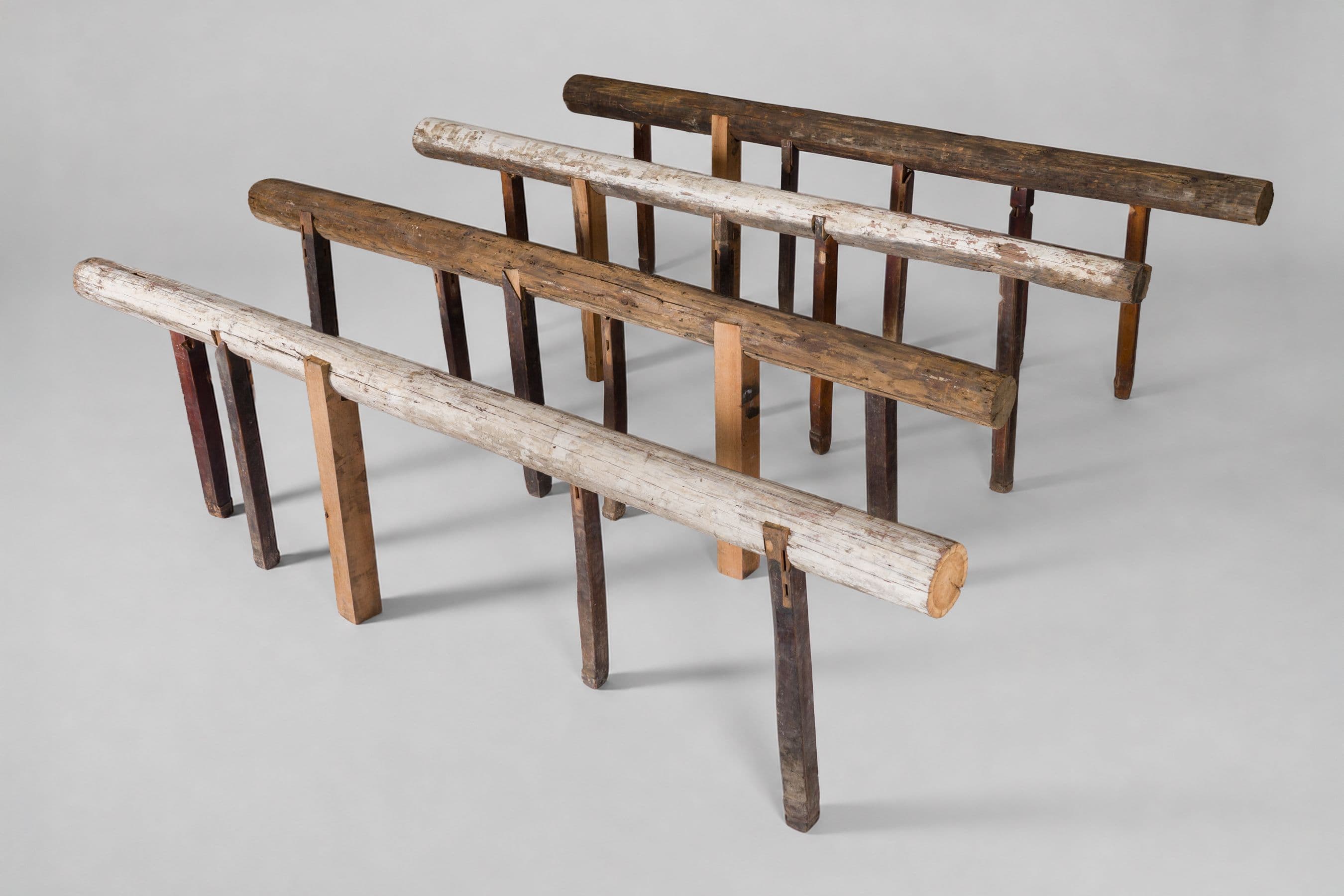
Qiu Jia’s practice resists easy classification as sculpture. His works no longer point toward a form that has been shaped into being; instead, they reveal a process through which an object gradually comes into existence within space, time, material, and relation. Wood, plaster, discarded tabletops, roof beams, table legs, trays, nails, and supporting structures are not merely materials from which his works are made. Each carries its own history and information, entering a new field of relations through the artist’s intervention. Rather than imposing an idea upon matter, the work emerges as a temporary state produced through negotiation, support, resistance, hesitation, and encounter between objects themselves.
Throughout this conversation, Wang Yamin deliberately avoids discussing Qiu Jia’s work through conventional artistic categories. Instead, she continually redirects the discussion toward the question of the object: material objects, everyday objects, art objects, social objects, symbolic objects, and the ways in which a work may return to the condition of material before once again becoming an artwork. Qiu Jia’s responses unfold less as theoretical propositions than as reflections on his own working method. He speaks of the grain and moisture of wood, of his bodily relationship with materials, of structures shifting from the interior to the exterior, and of works moving away from representation toward assemblage, from finished form toward an ongoing cycle of becoming.
At the heart of this dialogue lies a single question: how can an object come into being through instability, provisionality, low-tech processes, contingency, and support?
Qiu Jia initially worked with stainless steel, iron, wood, fiberglass, and other conventional sculptural materials. At this stage, his practice remained largely within the established vocabulary of sculpture. Yet once the discussion turns to wood, the conversation begins to shift toward the notion of the object itself.
Unlike homogeneous materials that can be fully controlled, wood possesses grain, direction, moisture, knots, and traces of growth. It demands interaction rather than unilateral manipulation. Gradually, wood ceases to function merely as a sculptural medium and becomes an object carrying lived experience, everyday associations, and symbolic resonance.
Wang Yamin:
Around the early 2000s, what people generally understood as sculpture was still largely based on working with what we simply called “materials.”
Qiu Jia:
At the time, I regarded it as a kind of experiment. I was trying different materials—stainless steel, iron, wood, fiberglass. My approach has always been fairly direct: I make something first, then look at it, and only afterward begin to think.
Wang Yamin:
You seemed to develop a sensitivity to materials from the very beginning.
Qiu Jia:
What matters to me is experiencing the material itself—to become the material, in a sense. Perhaps that is simply a habit inherited from studying sculpture.
Wang Yamin:
Sculpture has always been closer to materiality than painting. Matter occupies a more fundamental place within sculpture. Your idea of “becoming the material” is fascinating. It suggests an unpretentious encounter with matter itself.
But why did wood eventually become your primary medium?
Qiu Jia:
For me, metal is relatively homogeneous and predictable. It tends to submit to structural logic. Wood, by contrast, always carries an awkwardness—it has grain, direction, and an internal resistance that refuses complete control.
Working with wood is therefore less an act of mastery than one of negotiation. Every cut requires constant adjustment in response to the material’s own growth pattern. It reminds me of the story of Cook Ding carving the ox: the action is not imposed upon the material but follows its internal structure, allowing the movement to emerge naturally.
That was when I realized that making a work is not about imposing form upon matter. Rather, it is about allowing a relationship to emerge through the material’s resistance and its willingness to yield.
Wang Yamin:
Materials such as clay and metal are closer to elemental matter, whereas wood already exists as a distinct object. It bears evidence of growth, knots, cavities, and an internal structure. Clay and metal, by comparison, remain relatively homogeneous elemental materials.
Of course, elements are themselves objects of a kind. Both Chinese and Western philosophy have long contained materialist traditions that explain the world through fundamental elemental substances.
Within object-oriented ontology, however, this kind of explanation has often been criticized as a form of reductionism—a downward reduction that attempts to explain the object “wood” merely as an arrangement of elemental substances. Yet wood is already an object in the everyday sense. It is part of a tree that once lived. It possesses age, temperature, memory, mood, and history. It is already far more specific and individuated.
Conversely, to classify all such wood simply as “wood suitable for making tables” would be another questionable reduction—this time an upward abstraction through generalization.
So your shift in material was already a shift toward the specificity of the object itself. Later, when you began working with found tabletops and table legs, this movement toward the object became even more pronounced.
Qiu Jia:
In my own tactile experience, wood possesses an innate sense of intimacy. It establishes a relationship with the body more readily than other materials and feels more accessible, more inhabitable.
Perhaps this is why wood has traditionally been used to make ancestral tablets. It has long been understood as something capable of carrying the presence of the spirit.
At that point, wood ceases to be merely material. It becomes an open interface through which something invisible may attach itself and become manifest.
Wang Yamin:
Exactly. It draws the body into dialogue, and through the body, it also draws the soul into dialogue. In doing so, another kind of invisible object quietly begins to emerge.
As Qiu Jia’s practice evolved, wood itself underwent a transformation. It was no longer simply one category of material but became a constellation of objects carrying different origins, temporalities, identities, and traces of everyday life. Fragments of timber, discarded tabletops, table legs, roof beams, and other salvaged elements each retained their former functions, histories, and social associations. The artist’s task was no longer to construct a unified sculptural form from a single material but to allow disparate objects to enter into new relationships through assemblage, collision, and provisional structures. In this sense, the work shifted from wood sculpture toward an assemblage of objects.
Wang Yamin:
Wood is a living thing. It is the remains of a plant, the body of something once alive—a living object frozen in time.
Qiu Jia:
An object that exists across multiple dimensions.
Wang Yamin:
I think this reveals your intuitive sensitivity to the object itself. Every object possesses an inexhaustible richness of appearances, and its dimensions of truth can never be fully exhausted.
Qiu Jia:
People usually prefer to work with whole pieces of timber because they provide structural stability and consistency. Later, however, I began using fragments instead.
Compared to an intact plank, a fragment feels less stable, less homogeneous. Each piece carries its own difference and uncertainty. They rarely fit together precisely. Instead, they resemble patches temporarily joined together, constantly adjusted and renegotiated in order to sustain a fragile sense of coherence.
Wang Yamin:
I noticed that you gradually became drawn to increasingly individualized fragments—individual objects, rather than simply pieces of wood. Take the works incorporating sections of old tabletops, for example. Each fragment comes from a different table, carrying its own context, identity, age, colour, and tactile history. Once riveted together, these pieces no longer function merely as wood; they become objects filled with internal negotiations and layered relationships.
Your materials increasingly move away from elemental homogeneity toward individuality. They become more autonomous, more deeply marked by everyday use, and more saturated with the traces of different environments and histories. In other words, they become a plurality of objects.
One could even say that your practice has gradually developed into an assemblage of multiple objects, within which an ever-growing number of found objects are brought into play.
Qiu Jia:
Plaster also appears frequently in my work. In fact, plaster shares something important with these fragments of wood. Both exist in a state of incompletion, as traces temporarily preserved by time.
Within the tradition of sculpture, plaster is usually understood as a transitional material—a stage between the clay model and a final cast in bronze or another permanent medium. But for me, this transitional quality does not imply incompleteness in a negative sense. On the contrary, it is precisely within that unfinished condition that plaster reveals its own independent existence.
What interests me most is that which has not yet become a final result. It is simple, modest, and yet already exists.
Fundamental materials resemble the structural layers of architecture. They normally remain hidden beneath finished surfaces while supporting everything above them. Once these underlying materials are brought to the surface, they cease to function merely as an interior foundation; they become an exterior presence in their own right.
Wang Yamin:
What is significant here is that you draw plaster back into this negotiation among multiple objects. In doing so, you restore to plaster—something traditionally regarded as merely a material—the status of an individual object in its own right.
This section marks the conceptual turning point of the dialogue. Wang Yamin argues that conventional artistic categories—sculpture, painting, installation, performance, conceptual art—may ultimately obscure what is most fundamental in Qiu Jia’s practice. Rather than interpreting his work through the framework of sculpture, she proposes approaching it through the concept of the object.
What Qiu Jia engages with are not merely sculptural materials, but tabletops, roof beams, fragments of earlier works, plaster, spatial structures, systems of support, and the relationships among them. These are not passive materials waiting to be shaped; they are objects capable of entering into dialogue with one another and with the viewer. In this sense, Qiu Jia’s practice represents a shift away from medium-based thinking toward an ontology of objects.
Following their discussion of reclaimed tabletops and found materials, Wang Yamin proposes setting aside the category of sculpture altogether.
Wang Yamin:
Sometimes these tabletops are round, sometimes square. In most cases you have to cut and reshape them before using them, don’t you?
Qiu Jia:
Yes. Most of the tables I collect are incomplete, so they always require further processing.
Wang Yamin:
But they have already acquired form. Nature and history have already worked upon them before they reach you.
Your work increasingly takes the form of assemblages built from found objects. Conceptually, this continues the trajectory of your earlier work. They are still wooden objects, but now they have become far more individualised—objects that possess a fuller identity in their own right. They carry traces of everyday life. They are more independent.
Compared with the wood you used previously—which remained relatively abstract as an object—these tabletop fragments are far more concrete. They are social objects, reactivated through artistic reuse.
Personally, I would rather not rely on the category of sculpture anymore. Perhaps we should simply speak of objects.
If we adopt the object as our point of departure, distinctions such as sculpture, painting, installation, performance, or conceptual art become secondary. What ultimately confronts us are concrete objects themselves.
Sculpture has already become objectified.
Minimalism, for example, simply placed actual objects into the exhibition space, allowing them to generate a theatrical situation. In your work, however, multiple objects negotiate with one another before entering into dialogue with the viewer. It is less a theatre of sculpture than a theatre of objects.
In fact, I think some of your works—particularly those that resemble drums or mounds—establish a topological relationship between assembled tabletop fragments and the minimalist supporting structures that allow them to stand. This new topology simultaneously moves beyond both historical Minimalism and the readymade, producing a fundamentally different relationship: a new art-object.
Qiu Jia’s artistic trajectory begins with sculptural training and sculptural methods, yet ultimately arrives at the object itself.
Sculpture is therefore only his initial point of departure—a habitual language inherited from his education—not the final definition of his work.
Although the works still retain the scale, spatial presence, and structural qualities associated with sculpture, their internal logic has shifted toward a reorganisation of material objects, found objects, art objects, and structural objects.
For this reason, it may be more accurate to describe them not simply as sculpture, but as objects articulated through sculptural form—or, more succinctly, sculptural objects.
Wang Yamin:
What strikes me is that your practice increasingly employs the object in the form of sculpture.
This development feels entirely natural. After all, your training was rooted in sculpture. At first, like many artists, you approached sculpture as a medium held in your hands. Today, however, sculpture has become something you work through, rather than something you simply make.
By reflecting critically on the inherited assumptions of the sculptural medium, you gradually arrive at the object itself.
Another aspect I find particularly important is the way you flatten the hierarchy among everything you consider.
Traditional symbols, ethical values, ritual vessels and the Dao, methods of connection, raw materials, found objects, even space and dwelling—all of these become objects within the same conceptual field.
Rather than organising them according to predetermined categories, you place them on an equal plane where they negotiate, connect, and assemble themselves.
At the level of tangible things, one can trace a clear sequence:
material objects (wood, plaster, and so forth),
structural objects (mortise-and-tenon joints, nail guns, supporting devices),
found objects (tabletops, table legs, architectural fragments),
and even art objects (fragments of your own earlier works).
All these different objects negotiate with one another, eventually assembling into something that resembles sculpture—but is ultimately better understood as a sculptural object.
Qiu Jia:
One of the most intriguing aspects of making work is that the missing piece of material always seems to be waiting somewhere. More often than not, it has existed long before the work itself begins.
Wang Yamin:
Almost as though the encounter were destined.
What one ultimately encounters is always one of these objects along the trajectory we have been discussing. And the encounter itself already embodies an attitude of treating all objects as equals.
At the heart of the exhibition’s title, making objects stand is not merely about enabling roof beams, table legs, or wooden structures to remain upright in a physical sense. Rather, it concerns allowing an object to attain its own presence, dignity, and conditions of existence. Qiu Jia’s works are not sculptures in the conventional sense of modelling or shaping form. Instead, they allow objects to establish themselves—briefly yet convincingly—through instability, provisional support, and contingent relationships. In this sense, the question is no longer how to make a sculpture stand, but how an art-object comes into being.
Wang Yamin:
You once mentioned that tables often end up as discarded junk. Your work gives them another chance to stand—just as you do with roof beams, table legs, and other reclaimed elements.
But perhaps the more important question is not simply how to make an object upright, but how to allow it to stand on its own.
To stand is not merely a physical condition; it is a condition of self-establishment.
To allow an object to stand is to restore its dignity, its internal coherence, and even its inexhaustibility. The phrase itself carries a subtle anthropomorphic quality, suggesting that the object is able to occupy the world with its own sense of presence.
Qiu Jia:
Perhaps there is also a lingering trace of the sacred.
Wang Yamin:
Then the issue is no longer one of physical balance, nor merely a question of sculptural technique or formal construction.
Rather, it concerns the coming-into-being of an art-object.
Once this relationship has been established, we have already moved beyond the narrow, medium-specific understanding traditionally associated with sculpture.
The difficulty is that whenever we speak of sculpture—or even of Minimalism or Conceptual Art—we immediately begin to interpret the work through inherited historical frameworks. We place it within conceptual systems that have gradually lost their explanatory power.
My belief is that artistic practice is always changing. Every generation of artists, in every place, develops its own ways of working—whether advancing, retreating, or simply remaining still.
If criticism insists on approaching these practices solely through historical concepts, it inevitably lags behind the artists themselves.
Artists move forward by feeling their way through the concrete objects before them.
Critics should do the same.
Rather than relying upon concepts that have already become historical abstractions, we must also learn to engage with what stands before us as concept-objects.
Artistic practice, in other words, precedes theory.
Theory must learn to follow.
Qiu Jia:
Sometimes you are not making an object at all.
What you are really presenting is the relationship between objects.
That relationship itself becomes something like an event.
Wang Yamin:
And that relationship—that event—is itself another object.
It exists only in the present moment and cannot be reduced to anything else.
The same is especially true of the art-object.
The coming-into-being of the art-object is never confined to the existence of a physical thing alone.
About the Artist
Qiu Jia (b. 1977, Shanghai) received his M.F.A. from the Shanghai Academy of Fine Arts, Shanghai University, in 2004. In 2015, he was a Visiting Scholar at the Royal Academy of Arts, London. He currently lives and works in Shanghai.
Working across found objects, concrete, wood, plaster, resin, and clay, Qiu continuously investigates one of sculpture’s most fundamental questions: our relationship with objects, and the ways in which objects reveal themselves through processes of construction, dismantling, and reconfiguration.
His works function not only as visual experiences but also as experimental sites for reconfiguring perception. Through overlapping traces of ruins, ritual, and spectral presence, they continually test the possibilities for regenerating memory, tradition, and existence within contemporary society.
About Wang Yamin
Wang Yamin is a writer, curator, and holds a Ph.D. in Literature. She currently serves as Curator and Director of the Academic Department at the Art Museum of Nanjing University of the Arts.
Viewing exhibitions as an increasingly significant artistic medium in their own right, Wang has curated dozens of exhibitions and interdisciplinary projects featuring artists and cultural practitioners from China and abroad.
Her recent research focuses on processes of collective re-individuation and the reinvention of everyday life within contemporary technological culture. She has participated in exhibitions and artistic projects in China, the United Kingdom, Germany, and elsewhere, and has served as an international curatorial representative for both the Turner Prize and Hull UK City of Culture, as well as a participant in the Sino-French Curatorial Exchange Programme organised by the French Ministry of Culture.
Her writing has appeared extensively in art journals, exhibition catalogues, and other scholarly and curatorial publications.