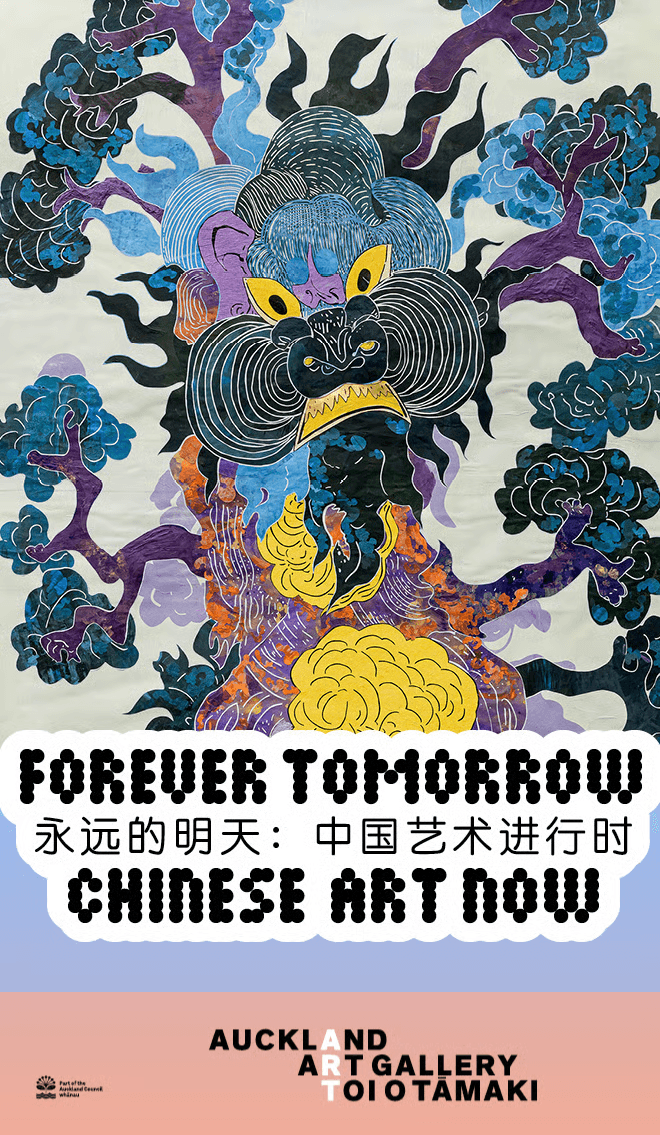
Forever Tomorrow: Chinese Art Now presents pioneering practices in contemporary Chinese art through a wide range of media, including sculpture, photography, and digital art. Grounded in the urgencies of the present, the exhibition explores key themes such as rapid change and social transformation. Beginning with China’s Reform and Opening-Up in 1978, it traces several decades of artistic development, focusing on how successive generations of Chinese artists have responded to profound shifts in the country’s social fabric—from rural to urban life, from tradition to modernity, and from industrialisation to an increasingly globalised world.
Wang Ziquan’s Compromise attempts to erase the skin, revealing the body’s underlying structure. This act of “erasure” is more than an X-ray-like exposure: it strips away the body’s outermost layer while probing the nervous system, the screen, and the skin itself. The series originates from a sculptural understanding of the human body. By scanning dancers to capture and preserve their movements, Wang abandons the body’s exterior shell in order to create a surface of revelation—one that offers direct access to what lies beneath.
Exhibition curator Hutch Wilco remarks:
”Forever Tomorrow: Chinese Art Now brings together powerful works that speak to lived experience—labour, migration, family, intimacy, and technology. Spanning different generations, these works demonstrate how artists give form to the emotional and psychological dimensions of everyday life. Taken together, they paint a vivid portrait of contemporary experience, inviting audiences to reflect on how these ongoing transformations continue to shape individual lives and our shared future.”
In Fortune Stick, Lu Pingyuan visualises the act of seeking guidance from another form of “living being” through algorithms. The resulting series of works on paper reflects a contemporary mode of divination, in which digital systems become new intermediaries between human uncertainty and invisible authority. Beyond the works themselves, Lu continues to create the conditions and contexts through which these new “deities”—born from the accumulated experiences of humanity—may intervene in everyday reality. In doing so, his practice reflects humanity’s enduring impulse to invoke an absolute Other: whether from the past, the unknown, or the cloud.
Through contemporary reinterpretations of traditional Chinese craftsmanship, imposing mechanical sculptures, and contemplative digital landscapes, Forever Tomorrow: Chinese Art Now reveals the complexity, innovation, and forward-looking vision of contemporary Chinese art. The exhibition invites audiences into a dynamic cultural landscape that is constantly evolving, offering a space in which to reflect on the shifting conditions of the present.
One of the exhibition’s highlights is Xu Zhen’s monumental kinetic sculpture Hello, whose form evolves from the architectural orders of ancient Greek temples. As visitors enter the gallery, they encounter what appears to be a colossal, mutated serpent composed of classical columns. Stretching across the exhibition space, it coils through the gallery, turning its gaze in different directions as if nodding in greeting to its audience. As one of the defining symbols of ancient Greek architecture, the classical column has long stood as an emblem of the origins and foundations of Western civilisation.
By combining the iconic form of the classical Greek column with the coiled, predatory posture of a serpent, the work invites viewers to reconsider their perception and experience of classical civilisation. The moment a visitor meets the gaze of its animated Corinthian capital becomes a moment of encounter—and mutual contemplation—with the profound history and cultural legacy it embodies. As Friedrich Nietzsche famously observed, “If you gaze long into an abyss, the abyss also gazes into you.” In an age of increasingly frequent encounters and collisions between global civilisations, Hello becomes both a literal presence and a powerful metaphor for the meeting of cultures across different histories and temporalities.
About the Artist | Lu Pingyuan
Lu Pingyuan (b. 1984, Zhejiang, China) lives and works in Shanghai.
Lu Pingyuan’s practice stems from his fascination with the intangible nature of human consciousness and spiritual will. Through the creation and deployment of stories, he explores how human experience is transmitted, transformed, and continually rewritten over time. Building upon this premise, he has developed a multidisciplinary body of work that weaves together art history, popular culture, and personal experience across text, video, painting, sculpture, and installation.
Combining surrealist narrative with conceptual art, Lu constructs an expansive fictional universe that exists parallel to reality. His works examine the spiritual dilemmas of contemporary life while seeking to recover the latent connections between human beings and the spiritual dimensions of the world around them.
His work has been exhibited widely in China and internationally. Recent exhibitions include Fortune Stick, HE Art Museum, Shunde, China (2024); The Gods Tell the People, the People Tell the Gods, MadeIn Gallery, Shanghai, China (2024); MU: Chinese Contemporary Perspectives, Centre Pompidou, Paris, France (2024); Cooking Lures, Lures Cooking, My Lovely Life, OCAT Shenzhen, Shenzhen, China (2022); the 11th Shanghai Biennale, Power Station of Art, Shanghai, China (2016); and the 9th Liverpool Biennial, Liverpool, United Kingdom (2016).
About the Artist | Wang Ziquan
Wang Ziquan (b. 1993, Shenyang, Liaoning, China) graduated from the Sculpture Department of the Central Academy of Fine Arts in 2017 and received his M.A. from the Royal College of Art, London, in 2019. He currently lives and works between Hangzhou and Shanghai.
Wang’s practice stems from his distinctive observations and understanding of the internet and virtual worlds. Exploring the threshold between the virtual and the real, he uses 3D software to simulate the absurdities of the physical world. Through narrative-based computer-generated imagery, he copies and pastes between virtual and real spaces.
Recent solo exhibitions include Under the Skin, Harkawik, New York (2024); Neural Sea, Qiao Space, Shanghai (2023); and Air Animals, MadeIn Gallery, Shanghai (2022).
Recent group exhibitions include Eternal Life, Nan Ke Gallery, Shanghai (2024); The Age of Encore, Times Art Museum, Beijing (2024); Ode to Kaiyuan, Yuan Art Museum, Beijing (2024); Following, Wind H Art Center, Beijing (2023); Demonstration: The Art of Decision-Making Technology, Fosun Foundation, Shanghai (2023); Astrological Magic, Golden Eagle Art Museum, Nanjing (2023); Scare the Muggles, By Art Matters, Hangzhou (2023); Illusion Glitch, Song Art Museum, Beijing (2023); HYBRID Biennale, HELLERAU – European Centre for the Arts, Dresden, Germany (2022); A Fractured Generation: Digital Colour, Networked Life, Fashion Consumption, Science-Fiction Prose, and Global Identity of the Post-1990s, Song Art Museum, Beijing (2022); Near Future – Perfect Partner, Yuelai Art Museum, Chongqing (2022); NOWNESS Short Film Awards Screening, Tank Shanghai (2022); USB Multi-Port Link Exhibition, MadeIn Gallery, Qiao Space, and in the PARK, Shanghai (2021); Hereditary Territory, Powerlong Museum, Shanghai (2021); Space Leader, APSMUSEUM, Shanghai (2020); The Image Feels Uneasy, MadeIn Gallery, Shanghai (2020); Martial Arts or Disco?, Wutong Space, Changsha (2020); Illusion Particles, MadeIn Gallery, Shanghai (2020); Art Nova 100, Guardian Art Center, Beijing (2019); Fragmentation, The Coningsby Gallery, London (2019); and Material Statement, Dyson Gallery, Royal College of Art, London (2019).
Wang was shortlisted for the Ashurst Emerging Artist Prize in the United Kingdom in 2020 and for the NOWNESS Short Film Awards in 2022. His works are held in the collections of major institutions, including The Bunker in Florida, USA; Song Art Museum, Beijing; Tank Shanghai; HOW Art Museum, Shanghai; 33 Art Museum, Guangzhou; and Cc Foundation, Shanghai.
About the Artist | Xu Zhen
Xu Zhen is an artist, curator, and cultural entrepreneur. Born in 1977, he lives and works in Shanghai, China.
A pioneering figure in contemporary Chinese art, Xu Zhen received the Best Artist Award at the Chinese Contemporary Art Awards (CCAA) in 2004. He first gained international recognition as one of the youngest Chinese artists selected for the International Exhibition of the 49th Venice Biennale in 2001. Working across installation, photography, video, performance, painting, and sculpture, his multidisciplinary practice continually expands the boundaries of contemporary art.
His work has been exhibited extensively at major museums, biennials, and international exhibitions worldwide, including the Venice Biennale (2001, 2005), The Museum of Modern Art (MoMA), New York (2004), the International Center of Photography, New York (2004), Mori Art Museum, Tokyo (2005), MoMA PS1, New York (2006), Tate Liverpool (2007), Hayward Gallery, London (2012), the Lyon Biennale (2013), The Armory Show, New York (2014), Long Museum, Shanghai (2015), Al Riwaq Art Space, Doha (2016), the 20th Biennale of Sydney (2016), the Solomon R. Guggenheim Museum, New York (2017), the Sharjah Biennial (2019), The Museum of Contemporary Art (MOCA), Los Angeles (2019), the National Gallery of Australia, Canberra (2020), and the Museum of Contemporary Art & Planning Exhibition (MOCAPE), Shenzhen (2024), among many others.
Alongside his artistic practice, Xu Zhen has played a significant role as a curator and cultural organiser. In 1998, he served as Artistic Director of BizArt Art Center, Shanghai’s first independent non-profit contemporary art institution. In 2006, together with fellow Shanghai artists, he co-founded Art-Ba-Ba, one of China’s most influential online platforms dedicated to the discussion and criticism of contemporary art.
In 2009, Xu founded MadeIn Company, an art production company centred on generating artistic creativity and exploring the limitless possibilities of contemporary culture. In 2013, MadeIn Company launched Xu Zhen®, a brand dedicated to artistic production and cultural innovation. This was followed by the establishment of MadeIn Gallery in 2014, MadeIn Museum in 2022, and the contemporary art platform DONG in 2025.
Curator | Hutch E. Wilco
Hutch E. Wilco is a curator, writer, and exhibition designer with nearly three decades of professional experience. Throughout his career, he has developed and delivered major museum and gallery projects across New Zealand and China.
Having lived in Shanghai for almost a decade, Wilco began his career in the city’s private art sector before establishing an exhibition design studio specialising in curatorial research and exhibition planning. He has curated exhibitions for many of China’s leading museums and art institutions, with a particular focus on artists working since the 1980s. In addition to his curatorial practice, he is a frequent contributor to international art publications.
About Auckland Art Gallery
Auckland Art Gallery Toi o Tāmaki is New Zealand’s leading visual arts institution, dedicated to presenting outstanding art, inspiring ideas, and serving diverse communities.
Housed in an award-winning building with four levels of exhibition space, the Gallery offers one of New Zealand’s largest and most inspiring visual arts experiences. Its holdings comprise more than 18,000 works, including significant collections of historic, modern, and contemporary New Zealand art, important works by Māori and Pacific artists, as well as selected international collections of painting, sculpture, and prints.
Located in the heart of central Auckland, the Gallery serves as a vital cultural platform, playing a central role in fostering inclusion, connection, and dialogue across the city’s diverse communities.