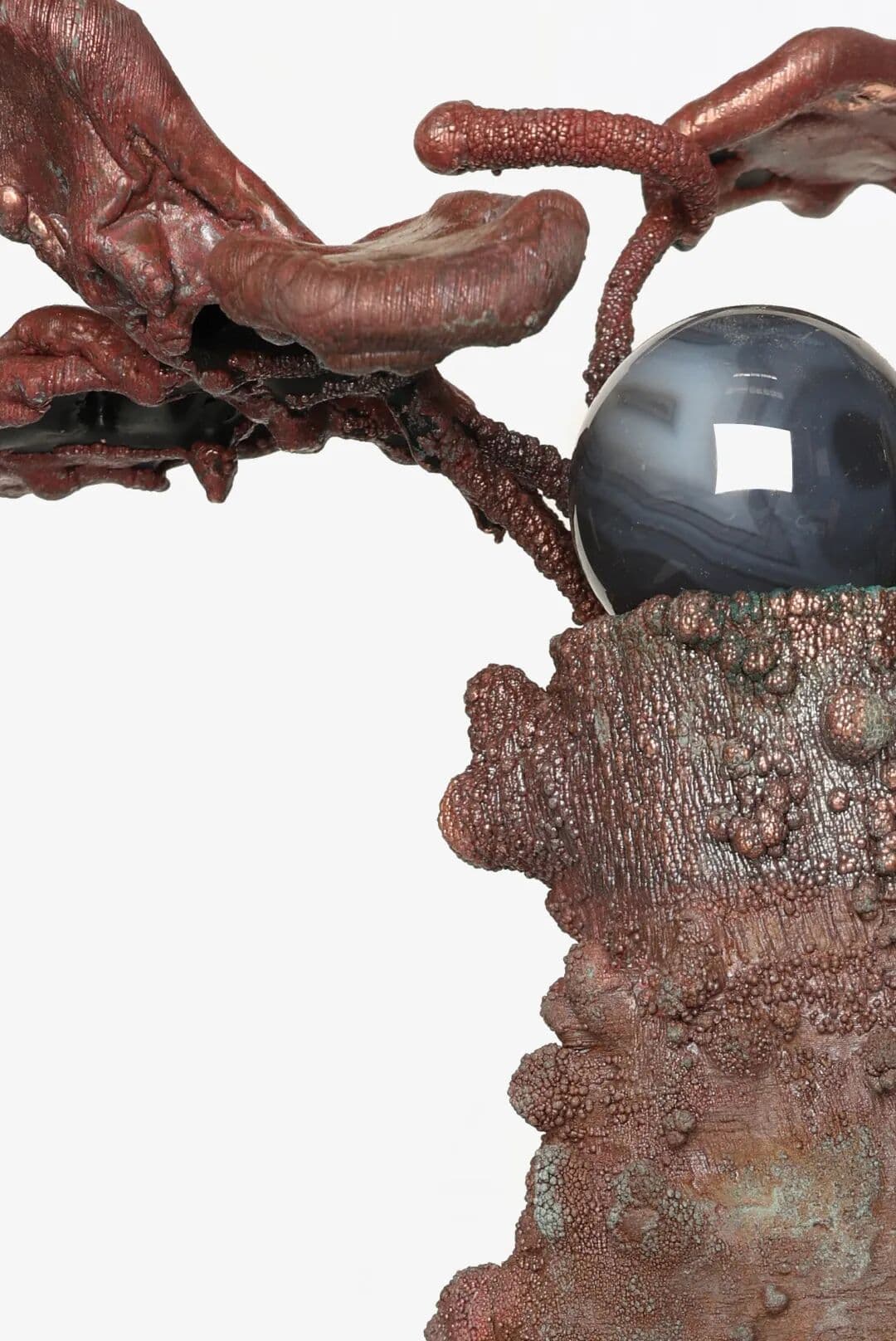
DONG HOL officially opened its group exhibition Invisible Infrastructure in May 2026. Bringing together works by Feng Zhixuan, Huang Juan, Lin Jiaxuan, Shao Fengtian, and Yao Tiao, the exhibition explores the invisible structures that quietly sustain everyday perception through fragmentary material practices, directing attention to the overlooked margins of the visual field.
HOL: Your paintings often evoke subtle emotional states—shyness, hesitation, awkwardness, or an indefinable sense of unease. What draws you to these elusive feelings that resist clear description?
Huang: They are probably the emotions I experience most often, and the ones that trouble me the most. As adults, we become adept at concealing them, yet they are accompanied by all kinds of desires—complex, dazzling, and unruly. Through my work, I hope to give form to these vast imagined states, because ultimately, no one remains untouched by them.
HOL: Your work often responds to the pressures, exhaustion, violence, and moral tensions of everyday life. Yet rather than depicting specific events directly, these experiences seem to dissolve into symbols, graphic forms, and elusive emotional states. How does this process of translation take place?
Huang: My response usually begins from something much more personal and everyday. The symbols, forms, and emotions in my paintings are all connected to specific people, places, moments, or objects. They emerge through a process of abstraction and transformation from these concrete experiences.
The way this translation happens is deeply personal. I’ve always been drawn to the immediacy and economy of simple line drawings, and I’m often fascinated by diagrams and graphic symbols created by people. Earlier in my practice, I made many purely abstract paintings, and those experiences continue to inform the way I work.
I don’t depict particular events directly because I feel that painting has its limits as a narrative medium. I tried working that way before—almost like keeping a visual diary—but it quickly became too literal and verbose. What ultimately interests me is not the event itself, but how it acts upon people, how it leaves traces behind, and how those traces continue to open a space for imagination.
HOL: Your paintings feature recurring symbols and fragments of the body. They appear quiet and restrained, yet they also suggest something suppressed or carefully contained beneath the surface. What draws you to this kind of emotional state?
Huang: That state is, in fact, quite ordinary. I wouldn’t necessarily say I like it—it’s simply as real and natural as keeping a diary. What I often depict is a condition of restraint. It’s in moments of pause that structures and underlying threads begin to emerge, and that’s closely tied to imagination.
I’ve always loved fairy tales and fables. They have a remarkable ability to use imagined scenarios to speak about fundamental truths, while at the same time inventing their own language. I find that relationship endlessly fascinating.
Conversation with Shao Fengtian
HOL: Your paintings draw on AI, smartphone photography, and oil painting—each involving a different mode of image-making. How do you decide which parts of the process to entrust to machines, and which must remain in your own hands?
Shao: To me, these different modes correspond to the dominant media of different historical periods. From oil painting to photography and now AI, machines have become increasingly efficient at absorbing and processing the cultural material we have already produced. In this process, reality as raw material and images as cultural output are positioned at opposite ends of the machine, while the human subject is gradually displaced from the centre.
Shao: The challenge is that machines often produce results that are merely good enough—averaged, standardised, and predictable. To avoid that, selection becomes a crucial part of the process. Within my own practice, the stages that require selection are precisely the ones that must remain manual. In a sense, the act of choosing has itself become what creation means today.
HOL: In your Abstract Painting series, each group of works differs noticeably in painterly language and atmosphere. Why was it important for you to preserve these differences rather than pursuing a unified style?
Shao: In the age of short-form video, the clips we scroll through may appear completely unrelated from one to the next. Yet taken together, they form an extraordinarily precise portrait of the user. In a similar way, the Abstract Painting series adopts the internet-era notion of “abstract” to construct a portrait of artistic practice today—one that reflects the totality of being a painter in the present. Serious, vulgar, entertaining, and improvised modes of painting are brought together into a single body of work.
Shao: As a maker, I’ve come to realise that I belong to a new era—one that requires us to part ways with the obsolete comfort of familiarity. This departure is not about inventing a new painting technique or establishing a stable visual style. Rather, it calls for new ways of seeing and new rules of the game, both of which demand greater engagement from the viewer. The differences between these works are therefore not deliberately imposed; they emerge as an inevitable consequence of this condition.
HOL: In this exhibition, the wooden panels, stretched canvases, and robotic arm structures function as more than simple supports. They reshape the works themselves and alter the way viewers engage with painting. How do you understand the role these materials play in your practice?
Shao: This approach continues from my 2024 solo exhibition New Clothes. By connecting the canvas to a robotic arm, the painting becomes a kind of screen. At the same time, the adjustable angles prevent viewers from immediately grasping the relationships between individual works or the exhibition as a whole. As they move through the exhibition, each painting gradually reveals itself. Every time the viewer begins to form a coherent idea, that understanding is disrupted, compelling them to move beyond a simple reading of appearances and instead consider the artist’s motivations, as well as the conceptual system that underpins the work.
Conversation with Lin Jiaxuan
HOL: Your work frequently incorporates everyday materials such as wood, cardboard, fabric, and metal—materials that are closely associated with architecture, furniture, and systems of support. What draws you to these materials as the starting point of your practice?
Lin: These materials are closely tied to my own lived experience. Cardboard comes from shipping boxes, pieces of wood are collected from fallen branches I encounter on walks, and the fabrics I use often come from everyday household items such as tablecloths or curtains. I think of these as the most authentic materials available to me because they are intimately connected to my daily life.
It is through the process of collecting, observing, and incorporating these materials into my work that connections naturally emerge—between myself and my own experiences, between family and memory, and ultimately between the individual and the broader social world.
Lin: Architectural elements, furniture, and support structures are all familiar man-made objects that appear necessary and immovable. They support our bodies and can also be understood as containers for everyday life. In daily experience, what tends to be emphasised is their functionality. Through the instability and fragility embedded in my works, however, I want to foreground these objects simply as things that exist in themselves. In doing so, looking becomes a repeated encounter with the materials and with the purposes they once served, while also raising questions about what constitutes the reality of the world we inhabit.
HOL: Your works often involve the displacement of traces—marble veining, symbols from instruction manuals or shipping crates, footprints—which are transferred onto entirely different materials. What interests you about this process of transposition?
Lin: We live amid countless buffers of cause and effect, where perceptual objects exist side by side. This is what makes the world seem stable, predictable, continuous, and governed by inertia. I want to interrupt that seamless experience and activate a more attentive, more comprehensive mode of perception as viewers encounter the work.
Creating this sense of displacement or visual estrangement provides the conditions for slower reflection. It’s like the difference between finding ice cream and mashed potatoes in the same waffle cone. As viewers try to identify the materials, the images, the relationships between them, and ultimately their own relationship to them, they are prompted to re-examine the experiences through which they understand their own lives.
Lin: At the same time, these visual traces carry information of their own, continually posing questions to the viewer. Can the stamp on a piece of industrial timber reveal where the wood originally came from? What might the size of a footprint or the pattern of its sole tell us about the person who left it behind? What movements of the earth are recorded in the veining of marble? And to what extent can the traces we leave behind inadvertently reconstruct our existence as physical beings?
HOL: In many of your works, materials lean against, conceal, support, or protect one another. How do you understand these relationships between materials? And how do they relate to the body or to lived emotional experience?
Lin: I see these relationships between materials as translations of intimacy and embodied experience. Here, intimacy encompasses both family relationships and the relationship between the self and the inner self. It is an attempt to give visual form to emotions that cannot easily be spoken.
Sometimes words reach the tip of your tongue but refuse to come out; writing them down feels easier. The emotional content of a letter exists in the space between the person who writes it and the person who receives it. What interests me is the role of the letter—or the sheet of paper itself—as a carrier, and the kinds of connections it establishes with the individual and with the emotions it conveys.
Within my practice, the materials—and indeed the works themselves—function more like letters or sheets of paper: they exist as intermediary media. Unlike an actual letter, whose boundaries are defined by language, I try to use the experience of objects, and of our relationships with objects, as the medium through which meaning and emotion are expressed.
Lin: For example, my use of cardboard grows out of the everyday experience of recycling. Every week, at a fixed time, I have to dismantle, flatten, and organise discarded shipping boxes. Larger cartons require the coordination of my entire body to compress them, sometimes folding them down into even smaller forms. Wrapping cardboard with wooden boards becomes a way of protecting the cardboard, even though, in the context of shipping, cardboard itself is typically the material used to provide protection.
The physical resistance of the cardboard as it pushes back against my body while I flatten it, the sharp marks left by a blade slicing through it, and even the sounds produced in the process all become essential parts of how I think about the material. These bodily encounters are not incidental—they shape the work just as much as the material itself.
Conversation with Feng Zhixuan
HOL: Your work often brings together technologies that belong to very different historical moments—algorithms, electroforming, ancient divination, and engineering structures. How do you see the relationship between the way we understand technology today and the way earlier societies understood nature or the cosmos?
Feng: Today, technology is generally understood through a narrative of linear progress—from the Stone Age and the discovery of fire, to the Bronze Age, the steam era, electricity and the internal combustion engine, and onward to computers, renewable energy, and artificial intelligence. It is presented as a history of continual advancement.
Modern technology has also become increasingly dependent on vast interconnected systems. Today, when we think about an engineering project, we instinctively place it within networks of material production, energy infrastructure, machinery, logistics, and standardised manufacturing. Take the construction of a defensive fortification as an example: even if it consists of nothing more than reinforced concrete, it still relies on cement plants, steel mills, mines, transportation networks, heavy machinery, and engineering standards. Technology is no longer simply a method held in an individual’s hands; it is the outcome of an entire complex system.
Feng: By contrast, although ancient technologies also served large-scale state projects—such as the Great Wall, hydraulic systems, and city fortifications—their fundamental processes could often be carried out using locally available materials, embodied knowledge, and direct person-to-person transmission. Techniques such as rammed-earth construction, brick firing, stone quarrying, wall building, kiln making, drainage, and surveying were forms of knowledge that could be acquired through the body itself. They constituted a collective technology accumulated through countless individual experiences.
What interests me is precisely this transformation: technology has shifted from something grounded in embodied knowledge, apprenticeship, and local materials into a structure sustained by vast technological systems. Modern technology increasingly distances individuals from technology itself, whereas ancient technologies engaged directly with the land, mountains, water, gravity, fire, and materiality.
By bringing together algorithms, electroforming, divination, and engineering structures, my work seeks to reintroduce personal experience, embodied judgement, and local materials into today’s highly systematised technological landscape. At the same time, it is an attempt to reconsider how human beings intervene in nature through technology, and to rethink the relationships between the individual, technology, and the natural world.
HOL: Many of your works incorporate objects that originally served specific functions within infrastructure—construction formwork, streetlights, riverbed structures, or, in this exhibition, survey stakes used to measure sea level. Designed as tools for measurement, construction, or systems of management, they nevertheless take on the appearance of monuments or archaeological remains in your work. What continues to draw you to these kinds of objects?
Feng: These objects each occupy a crucial position within contemporary engineering systems. Their abstract forms are the result of continuous refinement through the demands of material properties, structural mechanics, water flow, topography, construction efficiency, and long-term practical experience. In many ways, they can be seen as condensed embodiments of contemporary engineering knowledge.
Originally, they exist merely as small components within much larger systems. Yet once they are removed from their functional contexts of measurement, construction, or management, they begin to assume an entirely different status. They are at once tools and relics; they speak simultaneously of contemporary industrial civilisation and of speculative archaeological artefacts from the future.
What continues to fascinate me about these objects is their capacity to make technology, natural forces, and time visible at once. Although they were originally designed to serve a particular system, within my work they cease to function simply as utilitarian components. Instead, they become structures that can be contemplated, commemorated, and reinterpreted.
HOL: This exhibition focuses on the infrastructures that support perception while remaining largely unnoticed. In your view, what kind of environment shapes the way people perceive the world today?
Feng: Our perception of the world is formed within an environment that is highly engineered, platform-based, and increasingly shaped by infrastructure. We understand distance through high-speed rail, orientation through navigation systems, cities through elevated road networks, storms through drainage systems, and water through embankments, river channels, and flood-control structures. Nature enters our experience only after it has been measured, managed, and translated by infrastructure.
Contemporary cities are often criticised for lacking a sense of place, as though they have been absorbed into vast, standardised systems of infrastructure. Yet viewed from a broader historical perspective, this very homogenisation represents a more powerful form of civilisation. It continues a much longer trajectory: from Yu the Great’s flood-control works, to the roads, hydraulic systems, city fortifications, and administrative standards of the Qin and Han dynasties, and onward to today’s high-speed railways, ports, metro systems, utility networks, retaining structures, and platform infrastructures. Throughout its history, Chinese civilisation has continually organised nature, populations, and space through engineering.
My practice seeks to rediscover the place of human experience within this vast civilisation of engineering. More importantly, it explores the possibility of re-establishing a relationship between human beings, technology, nature, and lived experience from within these complex systems.
HOL: This exhibition focuses on the infrastructures that support perception while remaining largely unnoticed. In your view, what kind of environment shapes the way people perceive the world today?
Feng: Our perception of the world is formed within an environment that is highly engineered, platform-based, and increasingly shaped by infrastructure. We understand distance through high-speed rail, orientation through navigation systems, cities through elevated road networks, storms through drainage systems, and water through embankments, river channels, and flood-control structures. Nature enters our experience only after it has been measured, managed, and translated by infrastructure.
Contemporary cities are often criticised for lacking a sense of place, as though they have been absorbed into vast, standardised systems of infrastructure. Yet viewed from a broader historical perspective, this very homogenisation represents a more powerful form of civilisation. It continues a much longer trajectory: from Yu the Great’s flood-control works, to the roads, hydraulic systems, city fortifications, and administrative standards of the Qin and Han dynasties, and onward to today’s high-speed railways, ports, metro systems, utility networks, retaining structures, and platform infrastructures. Throughout its history, Chinese civilisation has continually organised nature, populations, and space through engineering.
My practice seeks to rediscover the place of human experience within this vast civilisation of engineering. More importantly, it explores the possibility of re-establishing a relationship between human beings, technology, nature, and lived experience from within these complex systems.
Conversation with Yao Tiao
HOL: Many of your works begin with old photographs, family images, or spaces from your childhood. Yet through processes of transfer and layering, the original images gradually become unfamiliar. How do you understand the relationship between photography’s claim to record reality and the uncontrollable transformations that occur through painting?
Yao: Reworking these old photographs is, for me, a way of reorganising fragmented memories and renewing past experiences. Photographs undoubtedly possess the quality of recording reality—they preserve traces of a particular moment in time and a specific place, fixing something that once existed.
For me, however, memory itself is never stable. Over time, it is continually overwritten, misremembered, and even reimagined. Once these photographs enter the realm of painting, they gradually detach themselves from their original function as evidence or documentation. Instead, they become something much closer to sensation, emotion, and the unconscious.
Yao: Transferring the photograph from paper onto a wooden panel is an extremely time-consuming process that depends on constant repetition. Throughout this process, the image undergoes changes that can never be fully anticipated: certain areas remain intact, while others crack, peel away, or give rise to entirely new textures. In many ways, these uncontrollable traces resemble the nature of memory itself—always incomplete, always fragmentary.
The repetitive labour also gradually shifts my state of mind into one of quiet drift. As I work, I often find myself thinking about places I once lived, fragments of childhood, or images whose origins I can no longer distinguish—whether they belong to reality or imagination. Gradually, through this repetition, I arrive at a rhythm that feels entirely my own. The unpredictable actions involved in painting slowly become, as the photograph is revealed layer by layer, a form of unconscious control.
For me, this process is essential. It feels at once like repairing something that has been lost and allowing certain memories to take root and grow again.
HOL: Your paintings often feature dampness, mould, worn fabrics, and old houses—things that seem to bear the slow erosion of time. What is it about this condition that continues to draw you in?
Yao: Before my grandfather passed away, he once told me, “When I die, I want to die in the old house.” It was during the Lunar New Year of 2024, when I had just begun developing my earliest works about my ancestral home. That year, my grandparents did something unusual—they left their house in town and returned to the ancestral home to celebrate the New Year.
When I spoke to them over video call, the silence on the other side of the screen felt strangely unfamiliar. The dialect I had always associated with them—so familiar, yet never entirely intelligible to me—had disappeared. All that remained was my grandmother speaking to me in Mandarin, the sound of water as my grandfather soaked his feet in a stainless-steel basin, and his heavy breathing as he slowly shifted his body with effort.
Yao: Throughout my practice, these seemingly small and ordinary things continue to accumulate and grow until they inevitably lead me back to the old house itself. It was once the home where I lived. Gradually, I came to realise that every home we once inhabited—but no longer do—eventually becomes an old house. That understanding has slowly become the central thread running through my entire practice.
Yao: The real turning point came when I came across a gold-powder painting that my grandfather and I had made together when I was a child. It prompted me to shift my attention back to the objects contained within space itself—as though the space had become a vessel for memory.
Looking at the rusted drawing pins and the indentations left in the wooden board, I suddenly realised that home is not simply the building itself. It is the traces that remain. And those traces are, in themselves, the material embodiment of time.
HOL: Many of the images in your work do not unfold in a complete or linear sequence. Instead, they behave much like memory itself—repeating, leaping across time, or breaking off unexpectedly. What draws you to this way of organising images? And how would you describe the relationships between them?
Yao: In my recent practice, I’ve consciously begun organising my family photo albums. I tend to label them with keywords such as “primary school,” “Shanghai World Expo,” “Songcheng,” or “primary school excursion.” After scanning the photographs, I continue sorting them into folders with titles like “Photos from the New House,” “Mirrors,” “Wardrobe,” “Butterfly Valley,” and “Cradle.” Beyond time and place, I also record the objects in the photographs that leave the strongest impression on me. My memory is deeply object-oriented—it’s often a particular object that suddenly recalls a conversation, a scene, or a single image from the past.
What’s important is that the images I currently work with come from periods of my life that were never thoroughly documented. These photographs are more fragmentary, more discontinuous, and in some cases blurred or incomplete. When they are reassembled, they come much closer to the way memory is actually experienced.
About the Artist: Feng Zhixuan
Feng Zhixuan’s practice centres on large-scale, site-specific sculptural installations. His formal language draws extensively from the histories and narratives of Chinese hydraulic engineering, civil engineering, and infrastructure, both ancient and contemporary. His works often take the form of barriers, monuments, monumental scientific apparatuses, or defensive structures. This engagement has led him to conceive of artistic practice as a form of systems engineering, with grand historical narratives serving as the conceptual framework that underpins his work.
Rather than adopting the Western conception of technology as a linear process of extraction and progress, Feng derives his thinking from Chinese engineering traditions, repositioning technologies of making within the complexity of natural systems in order to explore the boundaries of fabrication itself. His works crystallise moments of equilibrium amid conditions of instability and continual change. Through a poetic rearticulation of technology, they offer a new way of reflecting on the notion of impermanence.
About the Artist: Yao Tiao
Yao Tiao (b. 2002, Hangzhou, China) lives and works in Hangzhou. She graduated from the BA Fine Art programme at Goldsmiths, University of London in 2024. Her practice resonates deeply with the emotional landscapes and material encounters of everyday life.
Working as a Chinese artist who studied in London, Yao explores the complexities of identity and belonging, as well as the emotional experiences shaped by misunderstanding, isolation, and cultural dislocation. Through a repetitive process of layering, obscuring, and revealing, she revisits and transforms memories and emotions from the past, using material traces such as dampness and mould as metaphors for the passage of time and the transitions between different stages of life.
Her work often originates in memories of her grandparents’ rural ancestral home—a space that persists even in gradual decay. For Yao, this house functions both as a metaphor for family and as a vessel for personal and collective memory, offering a point of emotional anchorage and consolation amid the fluidity and uncertainty of contemporary life.
About the Artist: Huang Juan
Huang Juan (b. 1991, Chongqing, China) lives and works in Chongqing. Her practice grows out of the associative imaginings of everyday life. Emotional experiences such as obsession, doubt, awkwardness, and vulnerability are transformed through processes of distortion and obscuration into a formalised, semi-abstract visual language with a strong compositional logic.
Working in a mode akin to keeping a diary, Huang uses painting to respond to the forms of exhaustion, violence, and moral tension encountered in daily life. Her paintings frequently feature bodily fragments—particularly eyes and hands—that serve as direct indicators of emotional and psychological states. Repeated, meticulously arranged symbols are distributed across the pictorial surface like regimented formations embedded within pores, producing a visual language that is at once restrained, methodical, and quietly charged with emotional intensity.
About the Artist: Shao Fengtian
Shao Fengtian (b. 1994, Jiangsu, China) lives and works in Hangzhou. He considers himself a landscape painter, redefining the notion of nature through an ongoing dialogue with digital imaging software and AI image-generation systems. By navigating these constructed visual environments, he continually reactivates his own judgement about painting and the medium itself.
His recent solo exhibitions and projects include Across the Ocean @ You (Qianhuliu ART SPACE, Xi’an, 2021); Actually, It’s Not So Bad (PLATESPACE, Beijing, 2021); No Shaman at Xuanwu Lake (Taogu Park, Nanjing, 2019); Stiff Neck (two-person exhibition with Fang Zheng, Morning Gallery, Beijing, 2019); Six Pieces of Clothing (PLATESPACE, Beijing, 2018); and Creation and Reception (Remi Gallery, Ningbo, 2018).
About the Artist: Lin Jiaxuan
Lin Jiaxuan (b. 2002, Shenzhen, China) lives and works in London. She studied at Goldsmiths, University of London, and received her Master’s degree from the Royal College of Art. Working across sculpture, installation, and painting, Lin’s practice examines the hidden structures that quietly sustain everyday life by translating the material details of often-overlooked elements—such as bricks, ceramic tiles, and structural supports—that underpin our built environment.
Her practice involves the transformation and recombination of found objects alongside materials including wood, metal, ceramic, glass, and textiles. Through these material interventions, Lin reveals the underlying conditions concealed beneath the surfaces of domestic and natural spaces, exposing the ways in which they are shaped by the logics of contemporary industrial society.