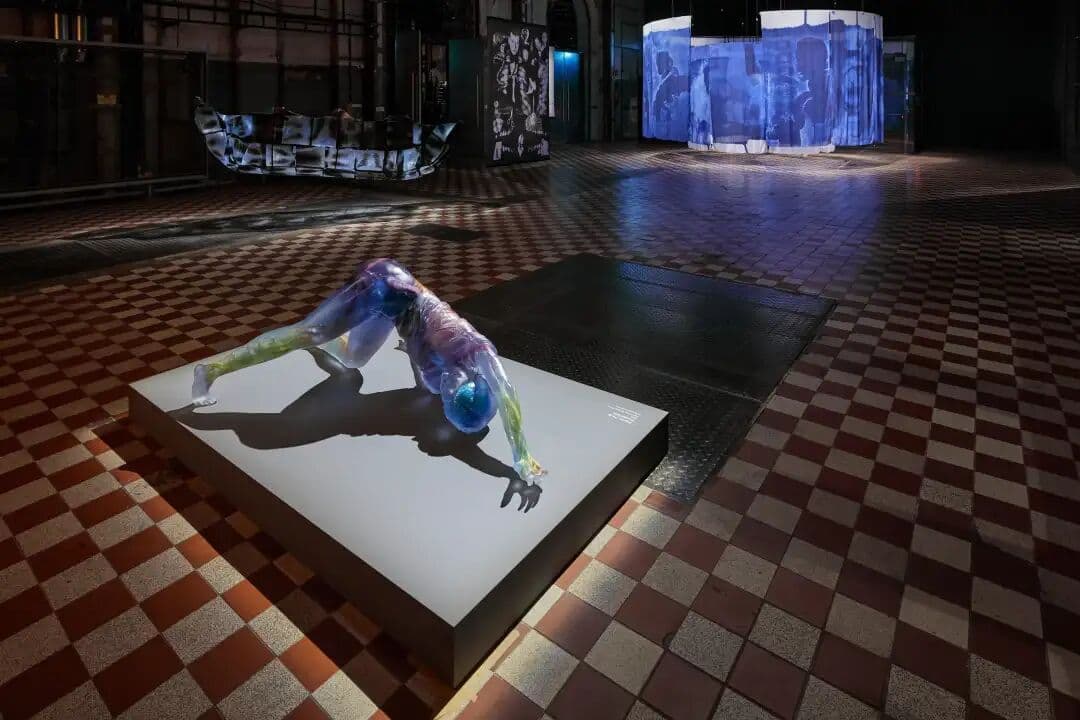
X-RAY is the world’s first exhibition to systematically focus on the phenomenon of X-rays and their profound impact on the histories of art, culture, and science. Presented in the Blower Hall and Compressor Hall of the Völklingen Ironworks, a UNESCO World Heritage Site, the exhibition begins with Wilhelm Conrad Röntgen’s discovery of X-rays in 1895, tracing how humanity’s exploration of the invisible began at the end of the nineteenth century and how X-rays fundamentally transformed medicine, scientific imagination, visual culture, and the development of modern art.
Taking the X-ray image as its central thread, the exhibition moves across the histories of science and art: from early experimental apparatuses and the shoe-fitting fluoroscope known as the Pedoscope, to X-ray satellites used to investigate dark matter in the universe; from the Transparent Man as an iconic image of the modern body, to the development of CT technology. Together, these materials reveal how X-rays have continuously reshaped human understanding of the body, matter, and space.
In November 1895, Wilhelm Conrad Röntgen discovered X-rays. News of this new form of radiation and its fascinating properties spread rapidly, generating intense interest among physicists, the medical community, and the wider public. The exhibition brings together works by numerous major artists from 1900 to the present, showing how artists have directly used X-ray imagery or reworked its visual logic through reconstruction, collage, and metaphor.
With its capacity to strip away surface appearances and reveal internal structures, the X-ray image became a crucial medium in modern art for moving beyond likeness and challenging the conventions of portraiture. X-ray images of the skeleton as self-portrait, the use of “transparency” to expose political power in satire, and the sustained gaze upon death, the body, and identity together form a visual tradition extending from modernism into the present.
Wang Ziquan’s Doubt attempts to erase the skin, revealing the body’s inner condition. This act of “erasure” extends beyond the logic of the X-ray image: it strips away the body’s outermost layer while probing the nervous system, the screen, and the skin itself. The series originates from a sculptural understanding of the human body. By scanning dancers to capture their movements, Wang relinquishes the body’s exterior shell, creating a surface of revelation that offers direct access to what lies beneath.
About Völklingen Ironworks
Völklingen Ironworks (Völklinger Hütte) is one of Europe’s leading centres for industrial heritage, contemporary art, and culture. Supported by the State of Saarland, the institution is responsible for the preservation, research, and activation of the UNESCO World Heritage Site. Building upon its industrial legacy, Völklingen Ironworks presents contemporary art exhibitions, cultural programmes, research initiatives, and public education projects that explore the historical and contemporary relationships between industry, society, and culture, transforming this landmark industrial complex into a dynamic platform for art and public engagement.
About the Artist: Wang Ziquan
Wang Ziquan (b. 1993, Shenyang, Liaoning, China) graduated from the Sculpture Department of the Central Academy of Fine Arts in 2017 and received an MA from the Royal College of Art in 2019. He currently lives and works between Hangzhou and Shanghai.
Wang’s practice stems from his distinctive observations of the internet and virtual worlds, exploring the threshold between the virtual and the real through the use of three-dimensional software to simulate the absurdities of lived reality. Working with narrative-based computer imagery, he continuously copies and pastes between virtual and physical spaces, constructing speculative environments that blur the boundaries between digital fabrication and embodied experience.